

At home, people sit on a chair a few times a day. In a restaurant it is dozens of times, and not gently: guests pull the chair in, lean back, drag it by the backrest, put a foot on the crossbar. A chair that serves perfectly well in a kitchen can work loose and wear out in a dining room within a year.
Here is what to check so that the chairs for your venue don't need replacing after one season.
Short answer
Three things matter for a restaurant: a sturdy frame with secure leg joints, fabric rated at 40,000 Martindale rubs or more with a treatment that can take daily wiping, and a sample of the model in your dining room before the whole batch goes into production.
Where a chair wears out first in a venue
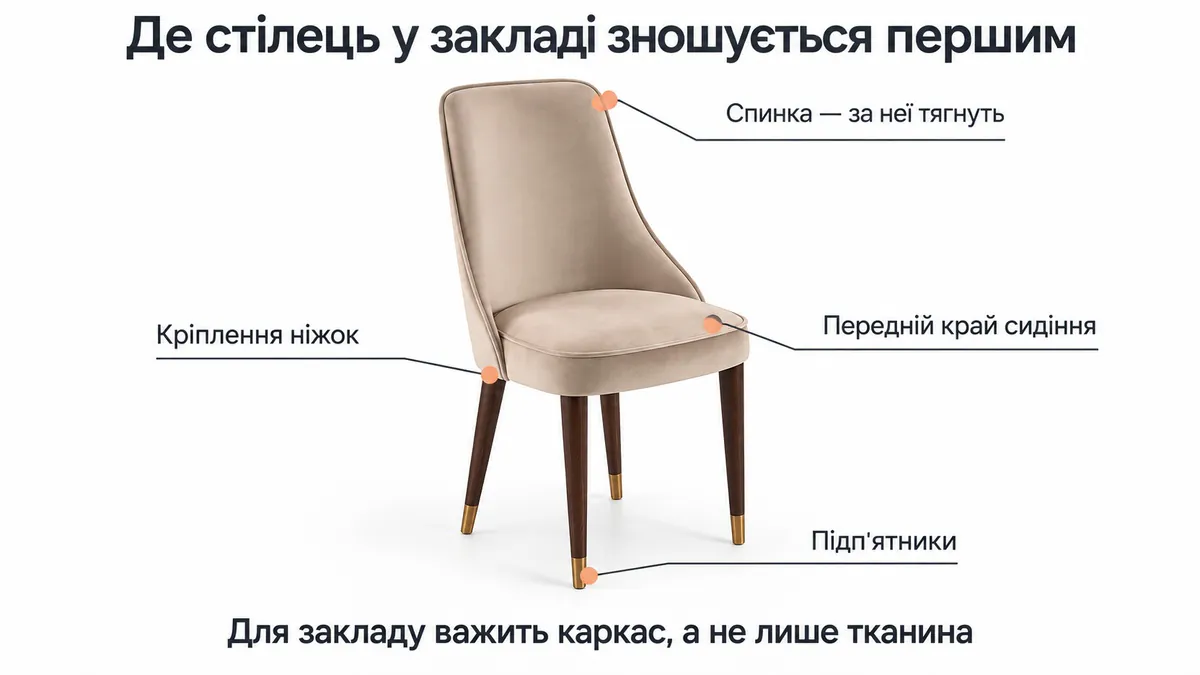
- Leg joints. Guests rock on the chair and push it back without standing up. The greatest load falls where the leg joins the frame. A wobbly chair is the first one in the dining room to be replaced.
- The front edge of the seat. People sit down on it and get up from it, so this is where the fabric rubs most and loses its look first.
- The backrest. It gets pulled to move the chair, and bags and jackets are hung on it. The backrest has to be held by the frame, not just the upholstery.
- Floor glides. The chair is pushed across the floor every day. Without glides, both the floor and the ends of the legs suffer.
Fabric: the Martindale test and treatment
The abrasion resistance of upholstery fabric is measured with the Martindale test: how many rubs it withstands before signs of wear appear. As a guide, 15–25 thousand rubs is usually enough for the home; a venue needs 40 thousand or more.

Look at the figure for the specific collection, not the fabric type. For example, the Divotex Monza collection is rated at 90,000 rubs, and Artex Allure Premium at 100,000.
The second thing that matters in a dining room is the treatment. Food, wine and grease get onto the upholstery, and it is wiped every day, more aggressively than at home. So for restaurants we choose collections with high abrasion resistance and a water-repellent treatment. And we always ask what the staff use to wipe the furniture: some cleaners are not compatible with certain treatments.
Fabric documentation
Every fabric comes with technical documentation from the manufacturer, including fire safety documents. For restaurants and hotels these can be required when the premises are inspected. Mention it at the specification stage, and the fabric will be chosen from those that have such documents.
Don't buy a batch blind
The most expensive mistake is forty chairs that looked right in the photo but didn't suit the dining room: the seat too high, the wrong shade under your lighting, too wide for the aisle.
So if a model is being developed for your venue, we first make one unit, once that model has been paid for. You assess the seat, the firmness and the fabric in your own dining room. If something needs changing, we change it before the batch goes into production, not after.
How many chairs and when
- There is no minimum order: from ten chairs for a coffee shop to furnishing an entire dining room.
- The shortest lead time for a batch is 7 days; beyond that it depends on complexity and volume. The manager gives you a timeframe straight after the brief, working to your opening date.
- The specification is kept on file: model, dimensions, fabric. A year later you can order more of the same chairs.
- Warranty: 24 months.
An example from our orders
60 Vapore bar stools for a venue in Lviv: black upholstery with diamond stitching on a black metal frame with a footrest. The metal frame was the venue's requirement: hundreds of sittings a day. On bar stool heights for a counter, see separately: bar stool or counter stool.
Terms for venues, examples and an enquiry form are on the furniture for restaurants page. If you are fitting out a café, see also café furniture in batches.
In brief
- The first to give way are the leg joints, the front edge of the seat, the backrest and the floor glides
- Fabric for a venue: 40,000 Martindale rubs or more; check the figure for the specific collection
- The treatment must stand up to the cleaner the staff use
- Ask for fabric documentation, including fire safety documents, at the specification stage
- One unit in the dining room first, then the batch
Restaurant chairs made for your dining room, starting with a single trial unit.
Get a quote →