


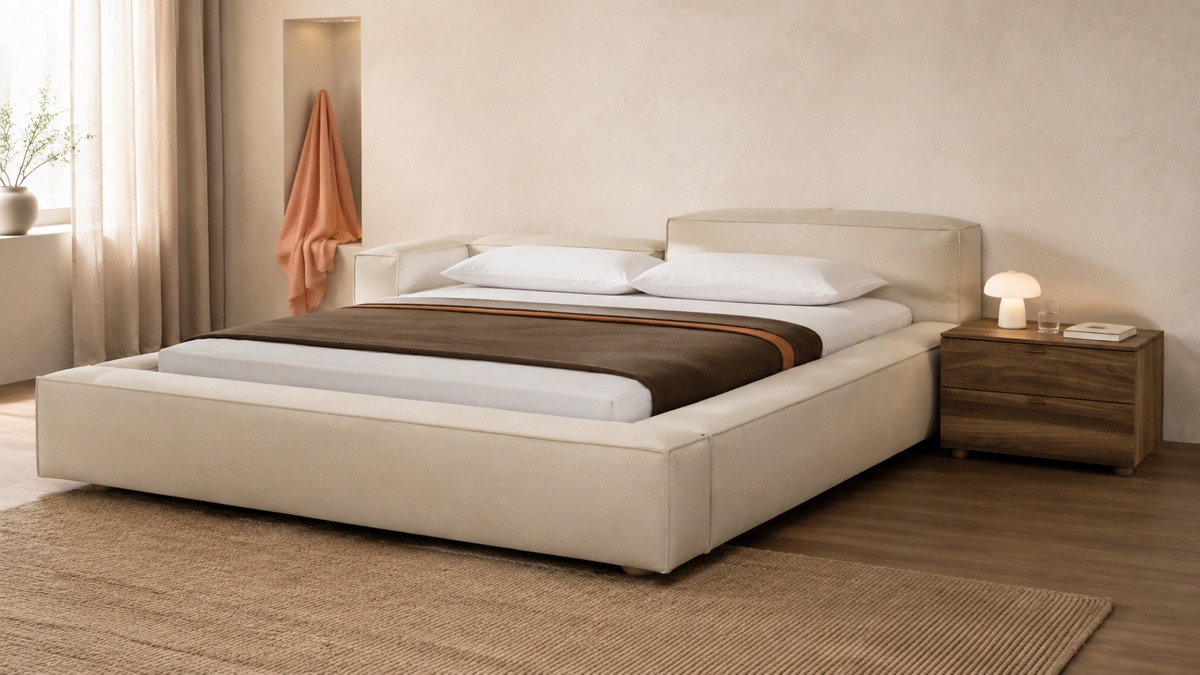
A bedside table is something you reach for in the dark. Glasses, phone, a glass of water. That is why its most important feature isn't a decorative one.
Short answer
The top of the bedside table should be level with the top of the mattress or 5 cm lower. For a low bed or a thin mattress, tables of 46–50 cm are right; for a bed with a lift-up mechanism or a thick mattress, about 60 cm. A depth of 40 cm is enough; work out the width together with the walkway beside the bed.
Height: go by the mattress, not the bed
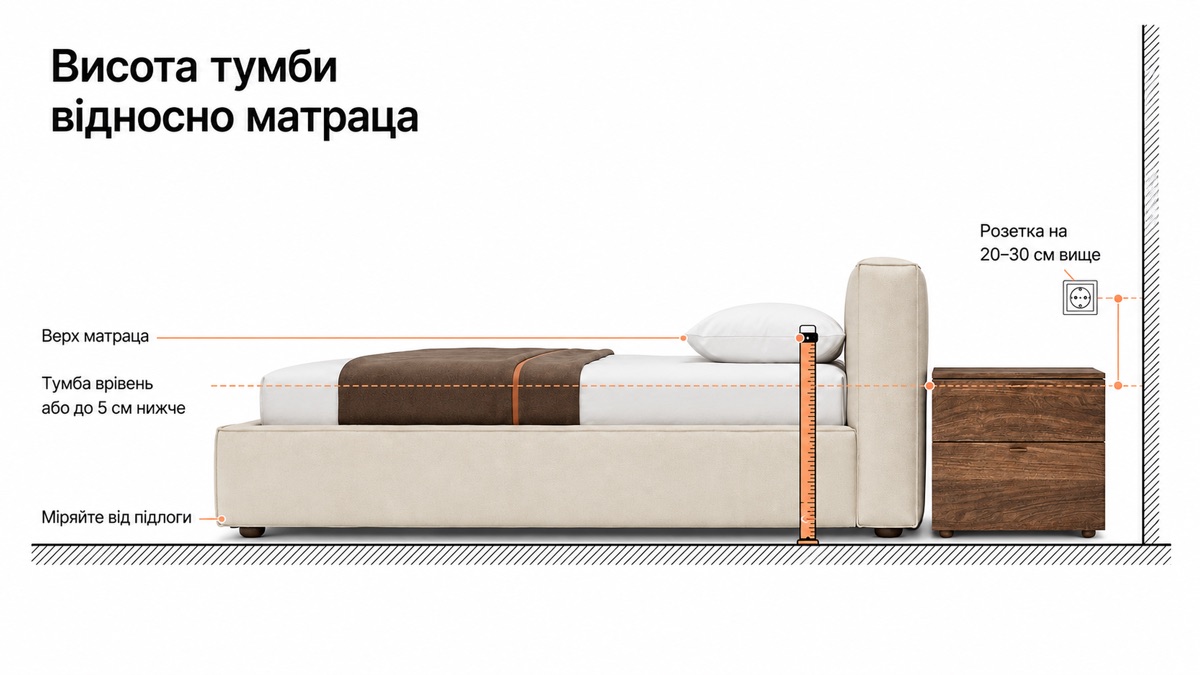
This is the rule that means most bedside tables are bought wrong.
The top of the table should be level with the top of the mattress or 5 cm lower. Not level with the bed frame, not "about the same", but level with the surface you reach from.
Why not higher: you have to lift your arm and feel around blind. Why not much lower: you reach down, and when half asleep that is the same problem, just in the other direction.
How to measure. Don't take the bed height from the specifications: it is usually given including the headboard. Put the tape measure on the mattress and measure from the floor. That is your figure.
In our range the heights go like this: Nagri, 46 cm, Nagri 4, about 49 cm, Chill 2, 50 cm, Nagri 2, 60 cm.
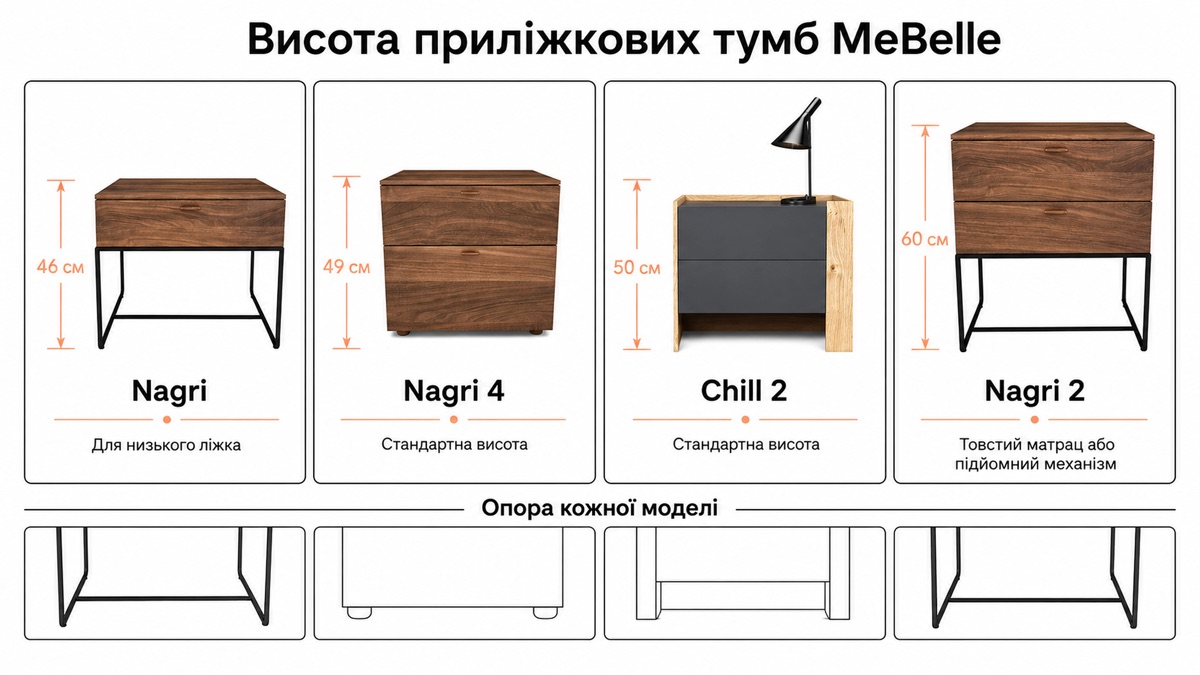
- 46–50 cm: for a low bed or a thin mattress. This is the most common case.
- 60 cm: for a bed with a lift-up mechanism or a thick mattress: the storage box adds height to the base, and an ordinary bedside table ends up too low.
Width: how much actually goes on it
Here people make the opposite mistake and choose one that is too narrow.
Count what stands on the table every night: a lamp (base diameter 15–20 cm), a phone, a book, a glass. That is already 40 cm of occupied surface, and there is only room left if the table is wider.
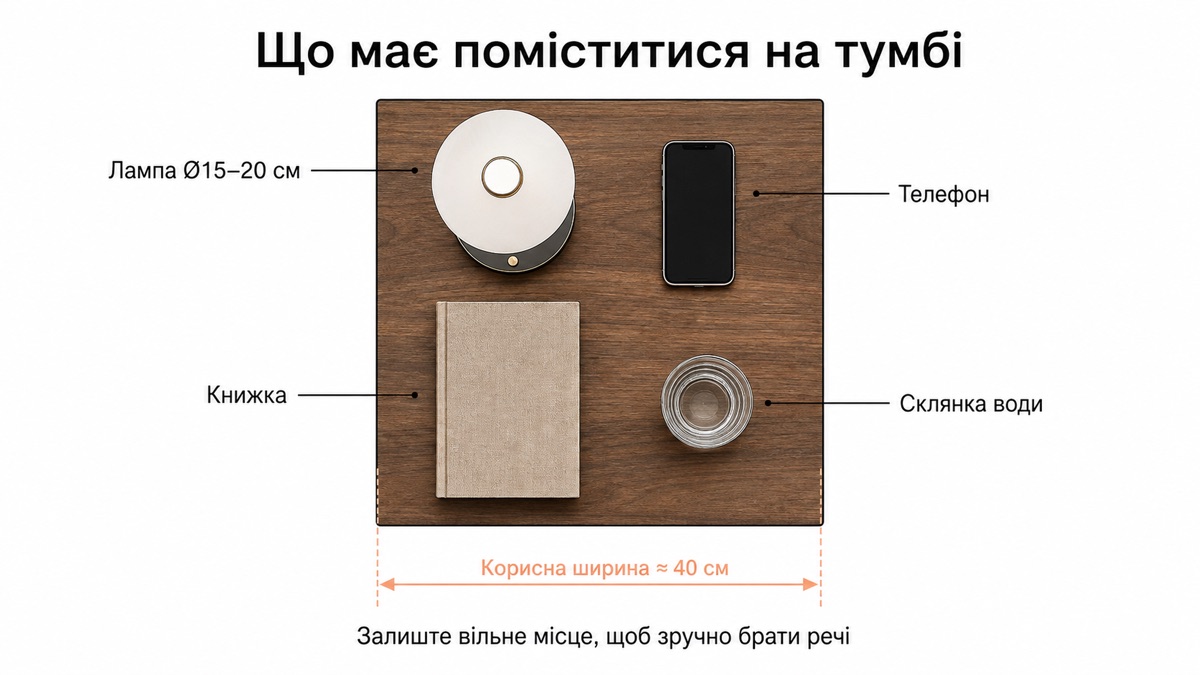
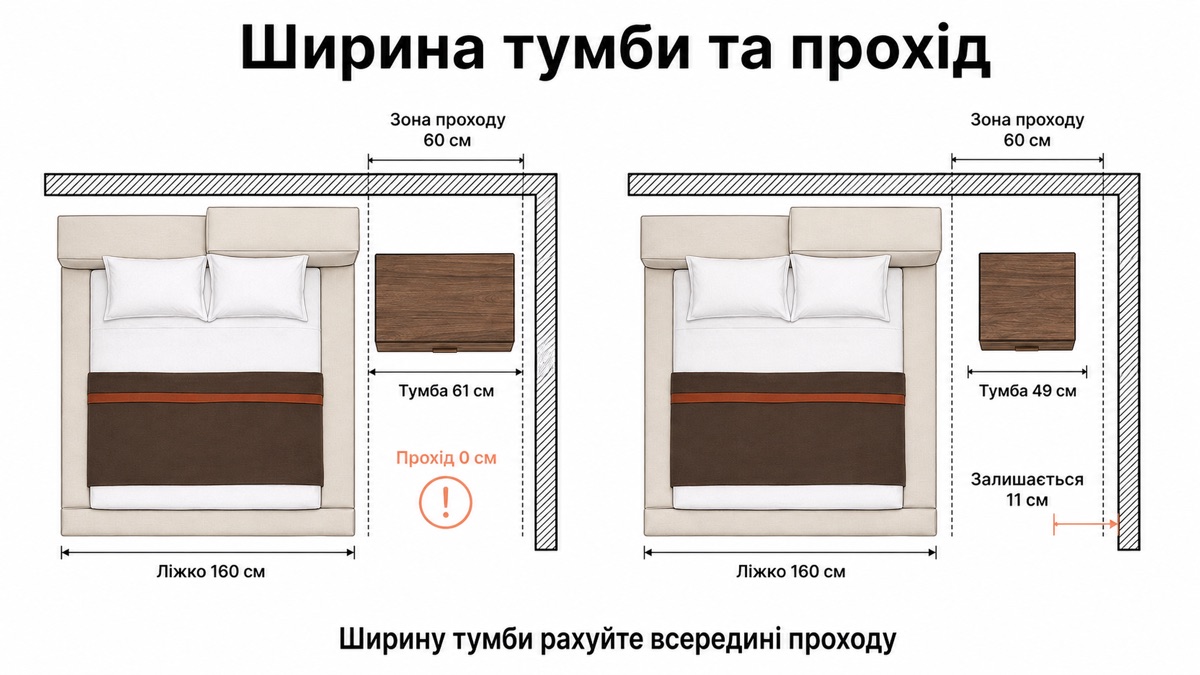
Our widths range from 49 cm (Nagri 4) to 61 cm (Nagri, Nagri 2); Chill 2 is 55 cm.
The rule for the room: the table should not stick out beyond the line of the headboard. If the bed is 160 cm and there is 60 cm of walkway on each side, a 61 cm table right next to the bed leaves 0 cm: the walkway disappears. Work it out together, not separately.
Depth: no more than your bed allows
Our tables are 40–48 cm deep. It seems a small thing, but:
A deep bedside table collects clutter. Whatever slides to the back of the drawer doesn't come out for years. 40 cm is a practical depth; more is only needed if the table replaces a chest of drawers.
The table should not stick out further than the bed. Otherwise you'll bump your hip on it every time you walk round the bed. Compare the depth of the table with how far the bed stands from the wall.
Legs: what you see from the bed
Lying down, you see the table from below, and what is under it too.
Metal legs in box-section tube (Nagri, Nagri 2): the table is raised and you can see the floor under it. The room feels more spacious, and vacuuming is easier.
Tapered wooden legs (Deshi, black): a warm option for Scandinavian interiors.
Concealed plinth base (Mode): the table reads as one solid volume, visually heavier but also more stable: you can lean on it when getting up.
Melamine-faced chipboard (Chill 2, Nagri 4): the simplest and cheapest option.
Two bedside tables or one
For a couple, two. One for two means someone reaches across their partner every night. It's not about symmetry but about each person needing a table.
For one person, one, on the side they get out of bed.
When there's no room for two: one bedside table plus a wall shelf on the other side. A shelf doesn't take up floor space and does the same job; see shelves.
The socket: the last thing people think of
This is exactly where the phone charges. If renovation is still under way, put a socket behind the bedside table at a height of 20–30 cm, not a metre away from it; otherwise the extension lead will be on view every night.
Planning furniture during renovation is covered separately: ordering furniture during renovation.
If you need a non-standard height
This is the piece where custom dimensions make the most sense: everyone's mattress height is different, but the grid of standard bedside tables isn't.
We make the height, width and depth to your size. Send the manager the height from the floor to the top of the mattress; that is enough to work it out.
In brief
- The top of the table: level with the mattress or 5 cm lower; measure from the floor to the surface of the mattress
- For a bed with a storage base, choose a taller table: 60 cm instead of 46–50
- Width from 50 cm, otherwise the lamp takes up the whole surface
- 40 cm is a practical depth; any deeper and things disappear and don't come back
- The table should not stick out beyond the bed, either to the side or forward