

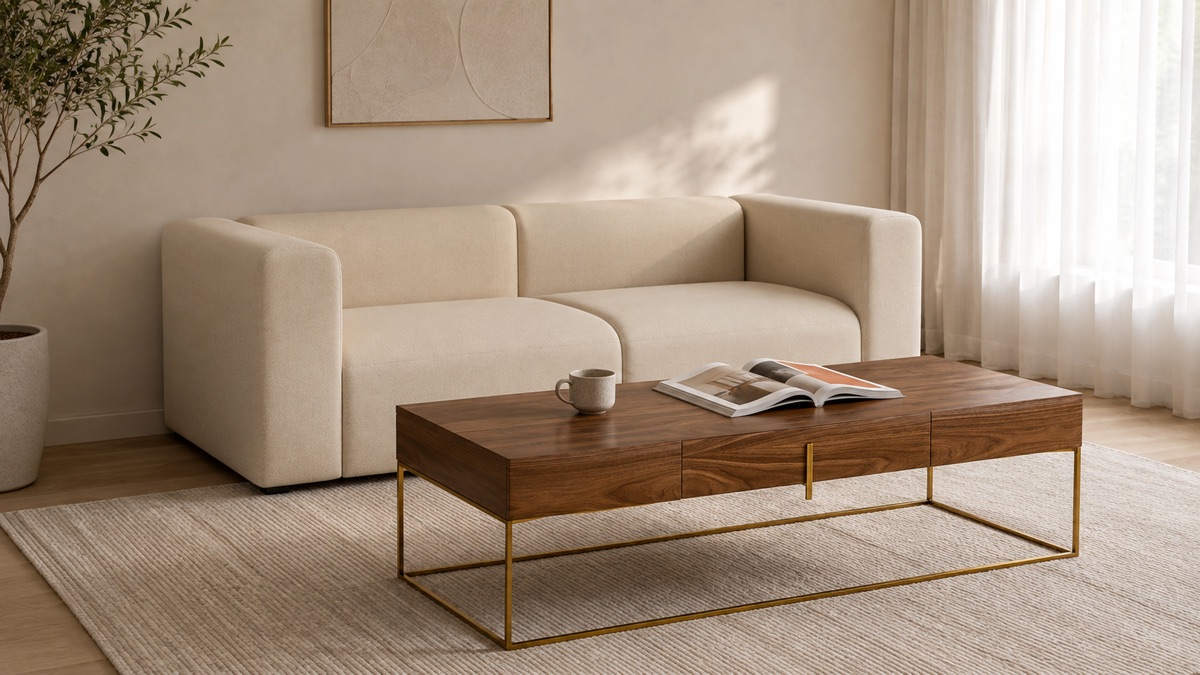
A coffee table is the only piece in the living room that has no logic of its own. It is always "for the sofa": for its height, for its length, for the distance you reach across to the table.
Short answer
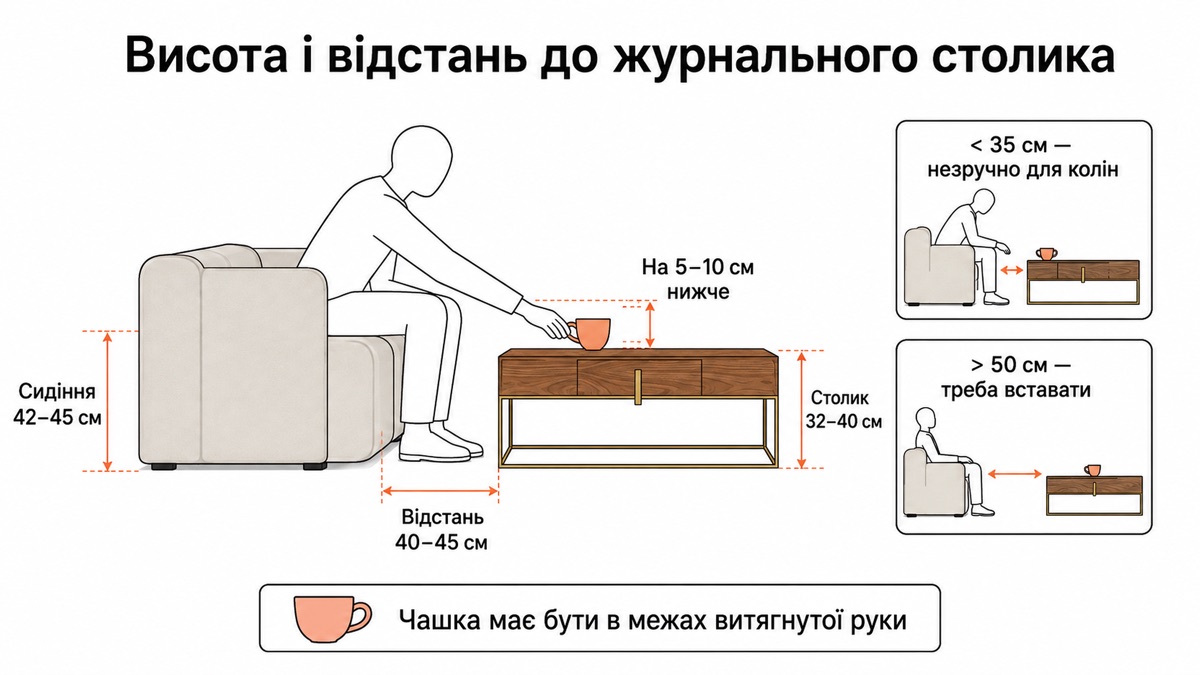
A coffee table should be 5–10 cm lower than the sofa seat. Most sofas have a seat of 42–45 cm, so the table should be 32–40 cm; 40 cm is the all-round height. The length is about two thirds of the sofa, and leave 40–45 cm between the edge of the seat and the table.
So measure the sofa first.
Height: lower than the seat, not level with it
The most common mistake is to choose a table level with the sofa seat or higher.
The rule: the table height is 5–10 cm lower than the sofa seat height. Most sofas have a seat of 42–45 cm, so the table should be 32–40 cm.
Why lower: when you are sitting, your hand moves down and forward. A table level with the seat makes you reach sideways with a straight back, and a higher one makes you lift your elbow. You don't notice it straight away, but after half an hour.
Our heights: ONLY, 30 cm, AMBER, 40 cm, DESHI, 45 cm.
- 30 cm: for a low sofa or a lounge seat, when people sit half-reclined.
- 40 cm: the all-round height for most sofas.
- 45 cm: for a sofa with a high seat; it is also high enough to eat at while sitting on the sofa.
Length: about two thirds of the sofa
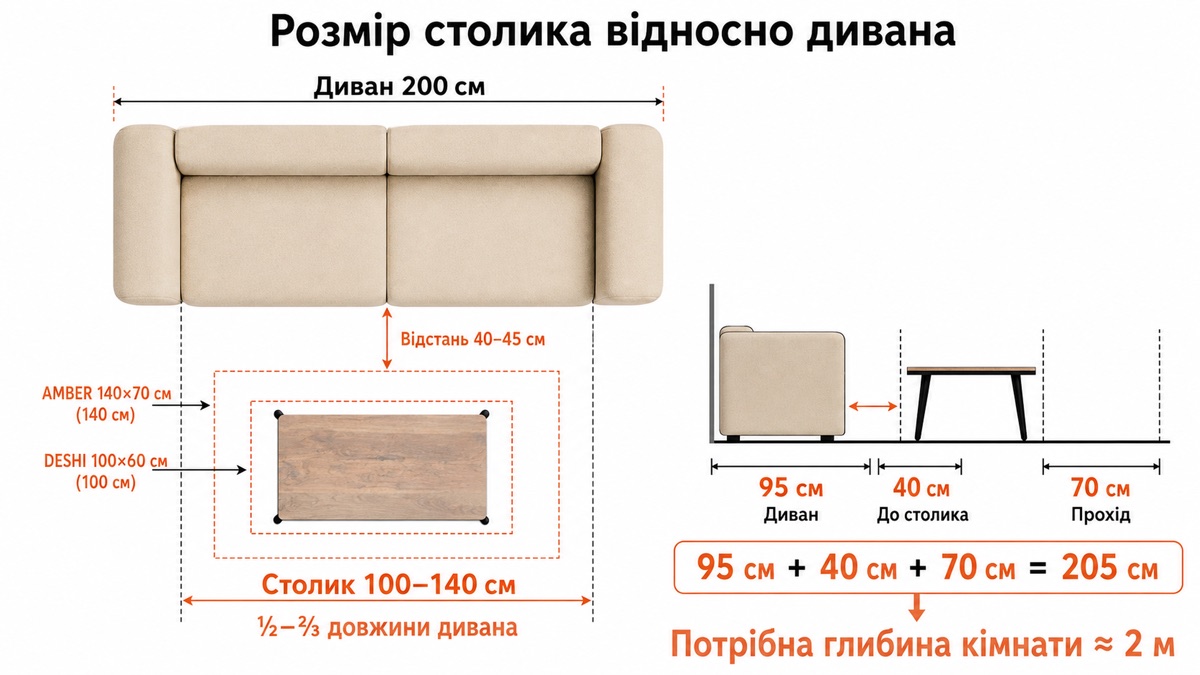
A table longer than the sofa looks like a mistake. One shorter than half gets lost.
The guide is from half to two thirds of the sofa length. For a 200 cm sofa that is 100–140 cm; for 240 cm, 120–160 cm.
Ours: ONLY, 69 cm (for a small sofa or an armchair), DESHI, 100 cm, AMBER, 140 cm (for a sofa from 210 cm).
Distance: the 40 centimetres that decide everything
A figure nobody ever measures, yet it decides whether the table will be convenient.
From the edge of the seat to the table: 40–45 cm. That is enough to reach your cup without getting up, while still leaving room to walk past and stretch your legs.
- Less than 35 cm: your knees hit it, and you have to squeeze past the table.
- More than 50 cm: you have to get up to take your cup. The table becomes decoration.
Add it up: a sofa 95 cm deep plus a 40 cm gap plus a 70 cm table is already 2 metres from the wall. In a narrow living room, this is where it turns out the table needs to be smaller.
Shape to suit the layout
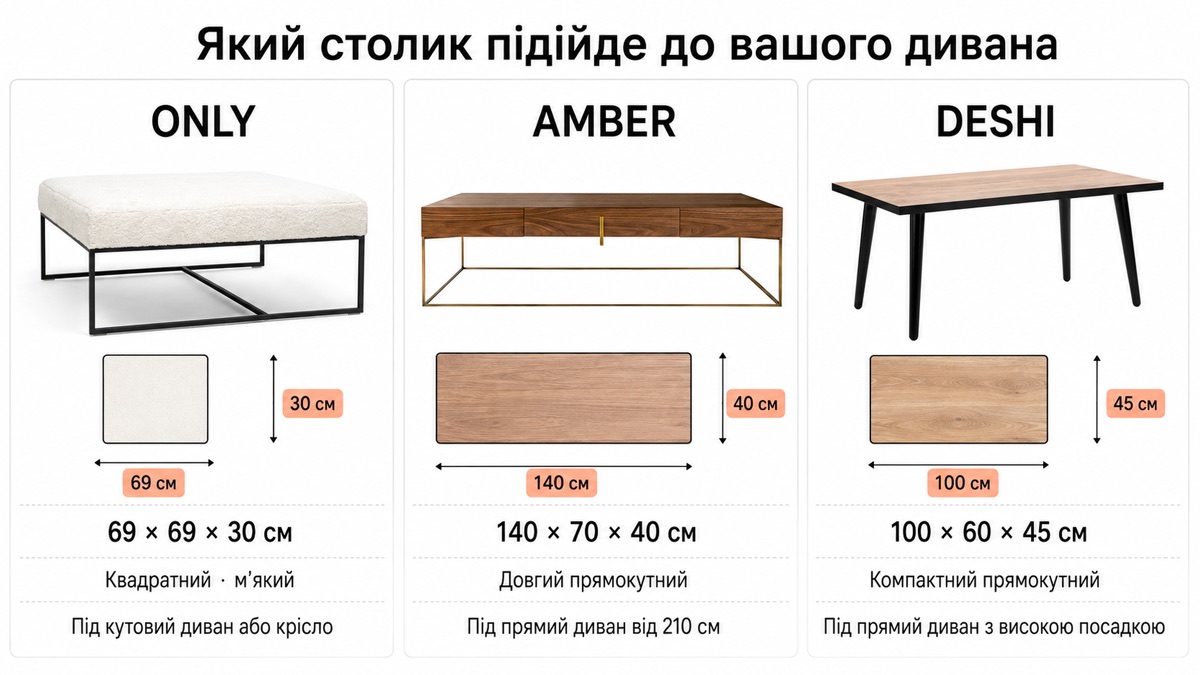
Rectangular (AMBER 140 × 70, DESHI 100 × 60): for a straight sofa. The lines are parallel, and the zone looks put together.
Square (ONLY 69 × 69): for a corner sofa or for armchairs around it. With a corner sofa, a rectangular table inevitably ends up at an angle to one of the sides.
Round or upholstered: where children run about or the walkway is narrow, since nobody gets hurt on a rounded edge. ONLY is upholstered: it is almost a pouf that doubles as a table.
Incidentally, a large pouf often works better than a table: it is soft, you can sit on it, and these models are deliberately lower. The breakdown: pouf size: 40, 50 or 100 cm.
Two details people regret
Glass. A glass top looks light and doesn't weigh the room down, but statistically it is the most frequently broken furniture, both in families with children and in rented flats.
An upholstered surface is not a table. If you choose an upholstered table (like ONLY), cups go on a tray. It is obvious, but people only remember it after the first time.
Made for your space
The height of the table is tied to a specific sofa, but the grid of standard sizes isn't. If your sofa has a low seat or, on the contrary, is a high model, our technologist works out the dimensions; it is a normal order.
Sofa dimensions to start from are covered separately: sofa dimensions.
In brief
- The table is 5–10 cm lower than the sofa seat: seat 42–45 cm → table 32–40 cm
- Length: from half to two thirds of the sofa length
- Distance from the sofa 40–45 cm: less and your knees hit it, more and you have to get up
- Rectangular for a straight sofa, square for a corner sofa
- Glass and children don't mix