

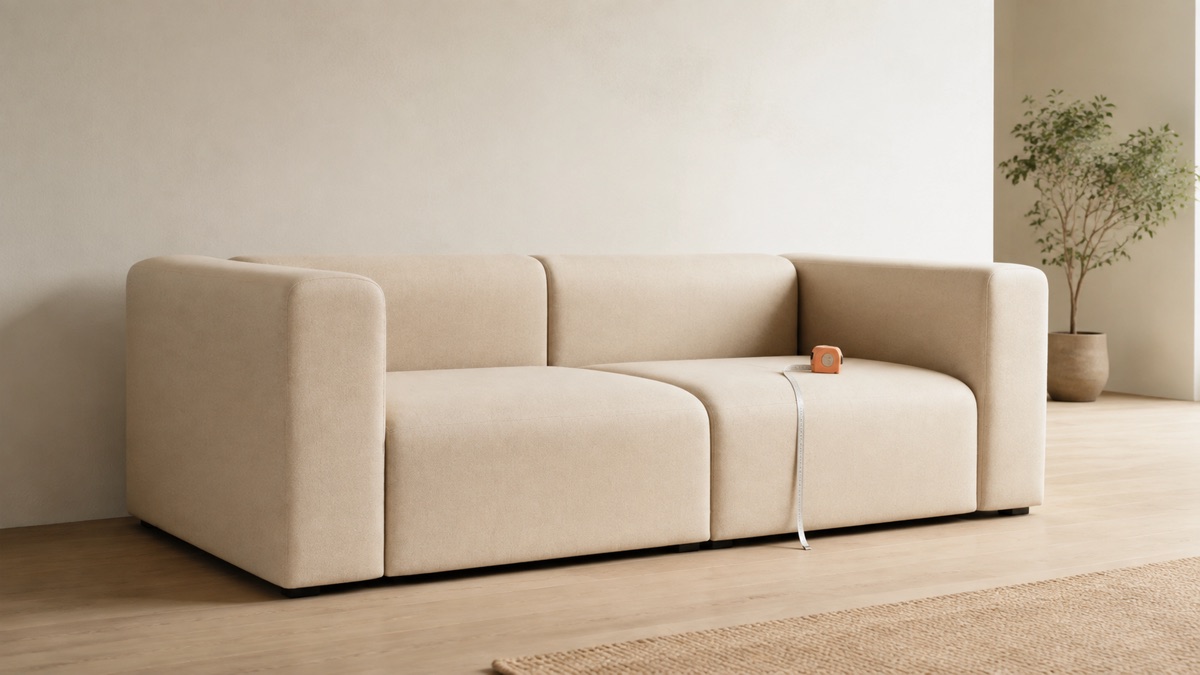
People choose a sofa by length: "so it fits into the 240 recess". That makes sense: length really does decide whether it will physically fit.
Short answer
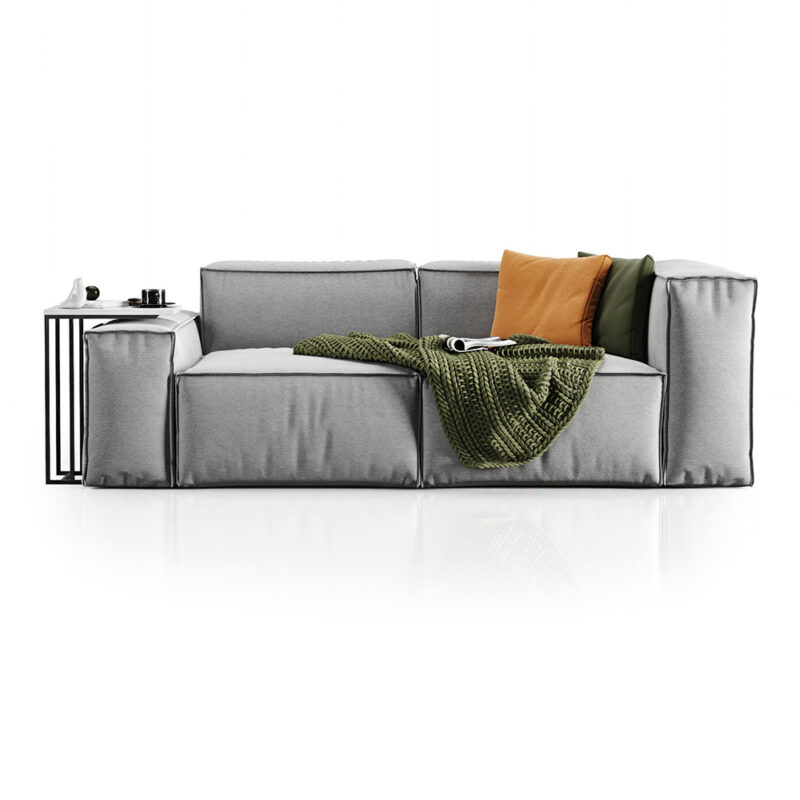
The seats of our sofas are 42–45 cm high, depending on the model; backrests range from 65 to 107 cm. For a room of up to 16 m², choose a backrest of up to 85 cm. Work out the seat depth as the overall depth minus 15–20 cm for the back cushion: 88–95 cm of overall depth gives 70–78 cm you actually sit on. Standard sizes of straight and corner sofas are in the sofa size table.
But comfort is set by two other dimensions. Depth decides how you will sit. Backrest height decides how the sofa will look in the room. Let's look at each separately.
Depth: the most important dimension nobody asks about
In our range of straight sofas, depth ranges from 70 cm (Novial) to 105 cm (MITRA). Thirty-five centimetres of difference make two fundamentally different pieces of furniture.
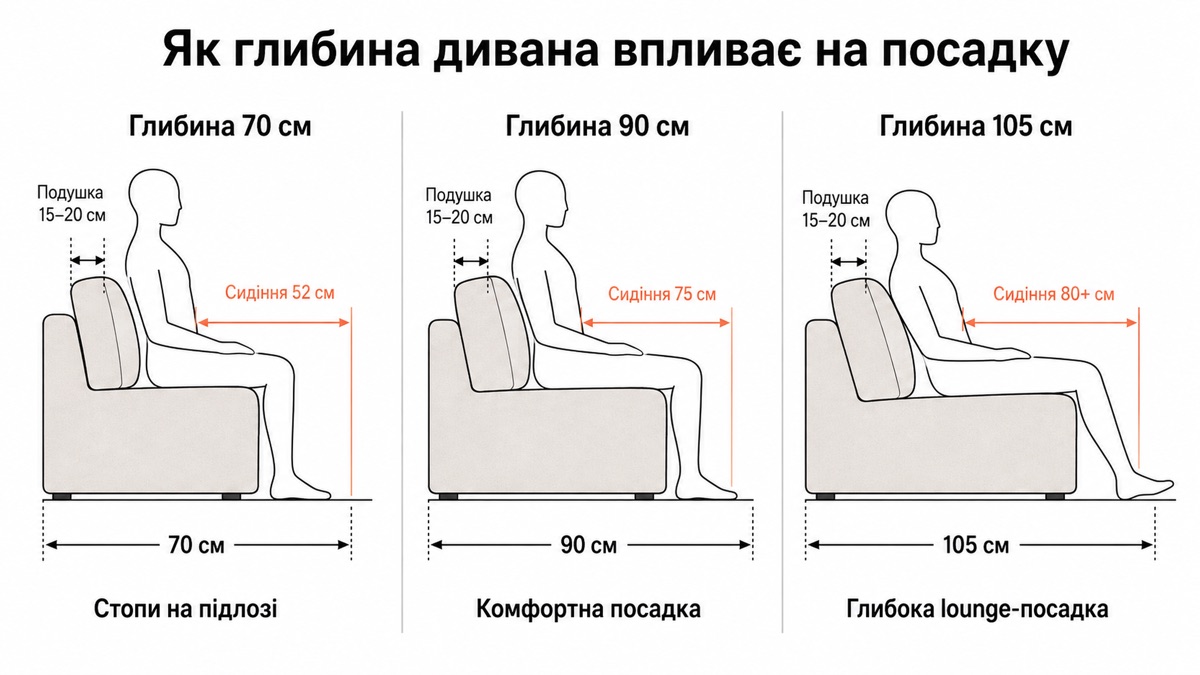
But the figure itself tells you nothing until you subtract the backrest. The back cushion takes up 15–20 cm, and what is left is the depth you actually sit on:
- 70 cm overall depth → a seat of about 52 cm. You sit upright, feet on the floor, back supported without effort. This is a "sitting at a table" position, for conversation and for working on a laptop.
- 88–95 cm → a seat of 70–78 cm. The all-round option: you can sit upright with a cushion behind you, or lean back and put your feet up.
- 100–105 cm → a seat of over 80 cm. Sitting upright is impossible here: for a person of average height, the thigh ends before the seat does, and the back is left without support. A sofa like this is meant for lying on or sitting with your legs up.
The main practical conclusion. A deep sofa isn't "better", it's different. If there is a shorter or older person in the family, a depth of over 100 cm will make both sitting and getting up harder. If the sofa is for evening TV series under a throw, then the opposite: choose a deep one.
It is easy to check: sit down and lean your back against the backrest. If your feet leave the floor or your knees don't bend over the edge of the seat, the sofa is too deep for you.
Backrest height: what the sofa will do to the room
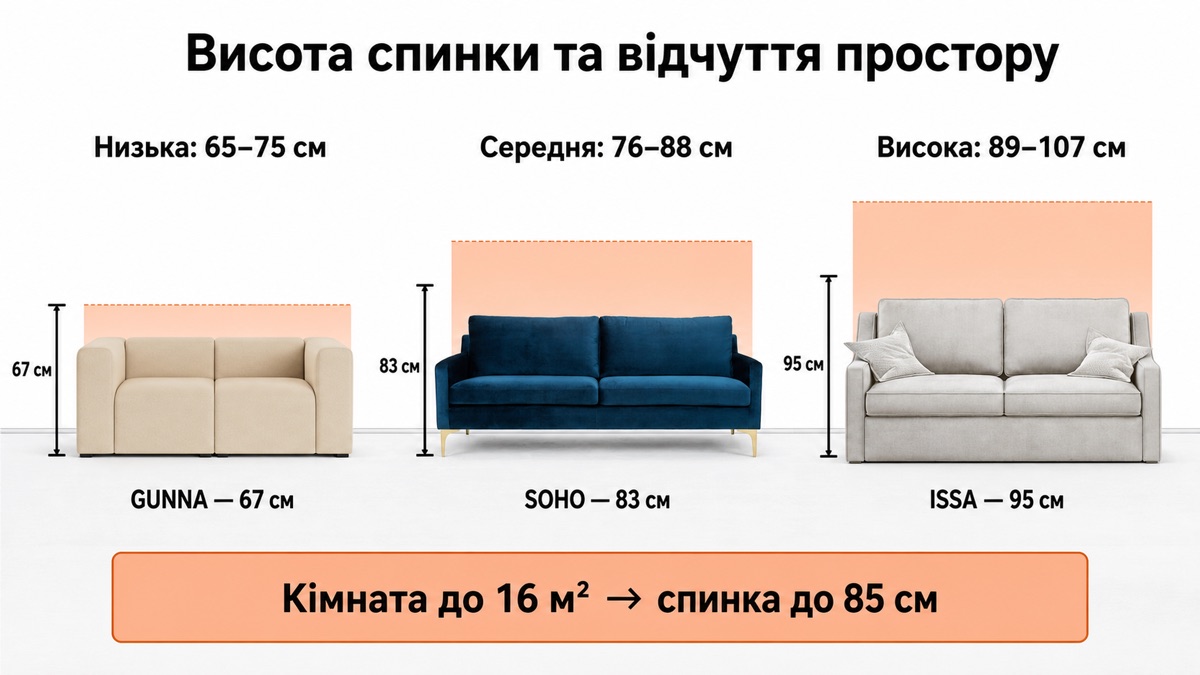
Here our range is even wider: from 65 cm (Mind) to 107 cm (NORDIK). Forty-two centimetres.
Low backrest, 65–75 cm. Visually the sofa isn't there: your gaze passes over it, and the room looks bigger. Ideal for a studio, for a sofa in the middle of a room, for the space in front of a window. The price: the backrest ends at shoulder-blade level, and there is nothing to rest your head on. That is fine for watching a film, but not for reading.
Medium, 76–88 cm. A compromise and the most common choice. Your back is supported along its whole length, your head isn't, but a cushion solves that.
High, 89–107 cm. Your head is supported and your neck relaxed, which you feel after just twenty minutes. But a sofa like this is a wall. Put it across a small room and the room is split in two. A high backrest only works against a real wall and only if the floor area allows.
The rule that saves you. In a room of up to 16 m², choose a backrest of up to 85 cm. A larger room can take any height.
Length: how many people will really fit
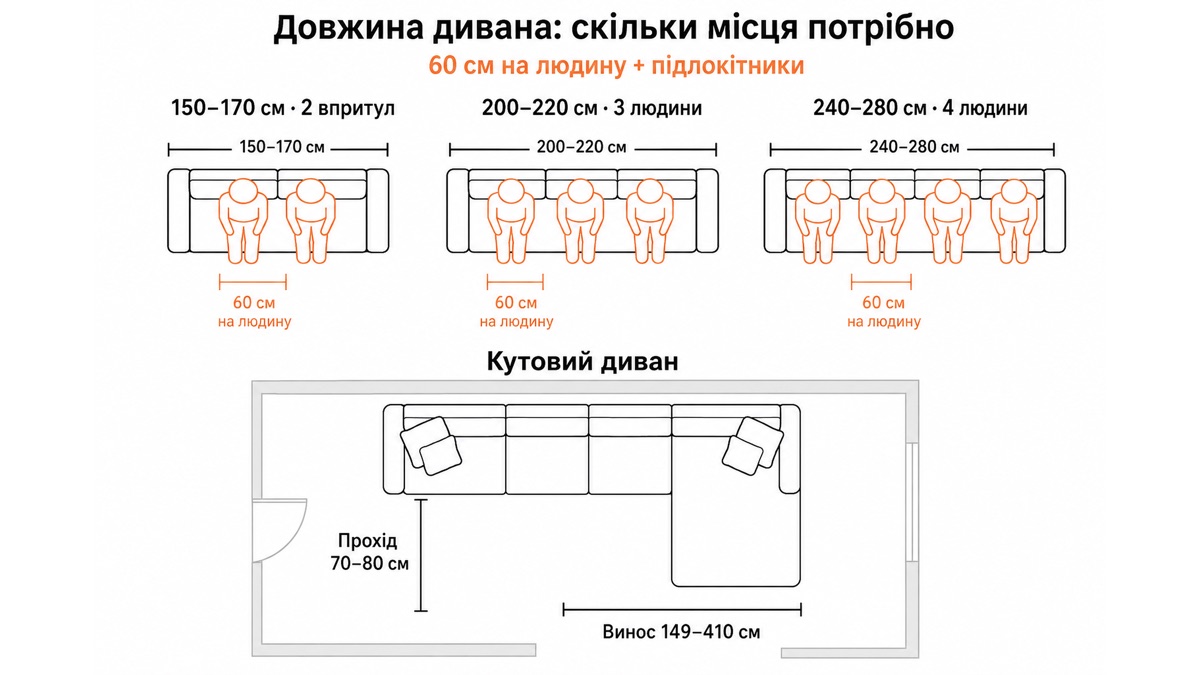
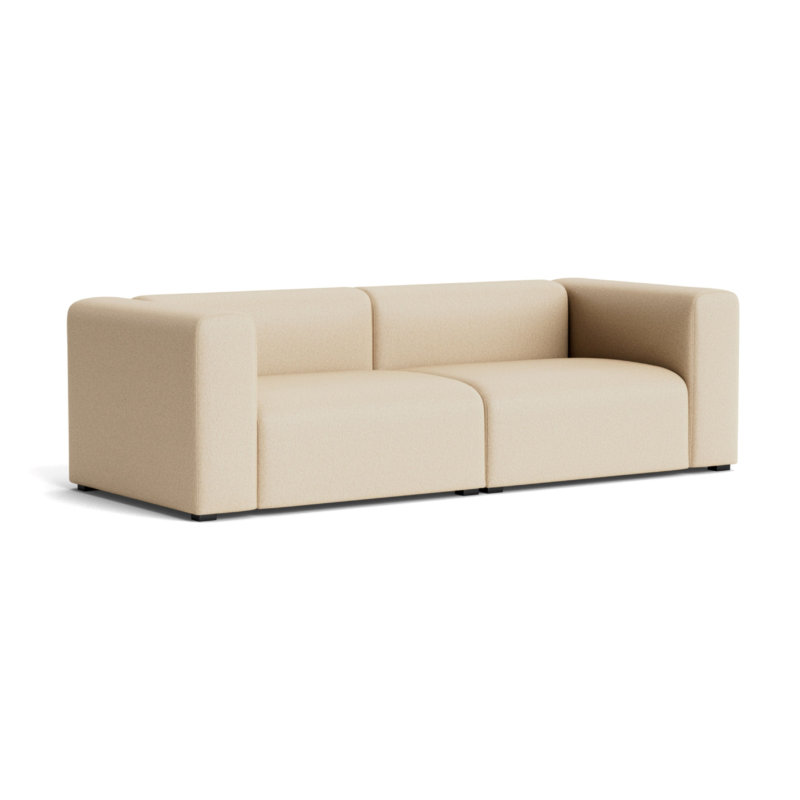
Our straight sofas range from 100 cm (PRACTIK) to 280 cm (Tariko). Counting seats is simple: one person needs 60 cm, plus 15–25 cm for each armrest.
- 150–170 cm: two people, close together. Really it's "one and a half seats": two can sit, but not sprawl.
- 200–220 cm: three without strain. The most popular size and the best balanced.
- 240–280 cm: four, or three with plenty of room. Needs a wall at least 60 cm longer, otherwise the sofa will look squeezed in.
A detailed size table for all models is in a separate article: sofa sizes.
Corner sofas: the dimension people get wrong
With corner sofas people almost always make a mistake, and always the same one: they measure the length of the main part and forget there is a second one.
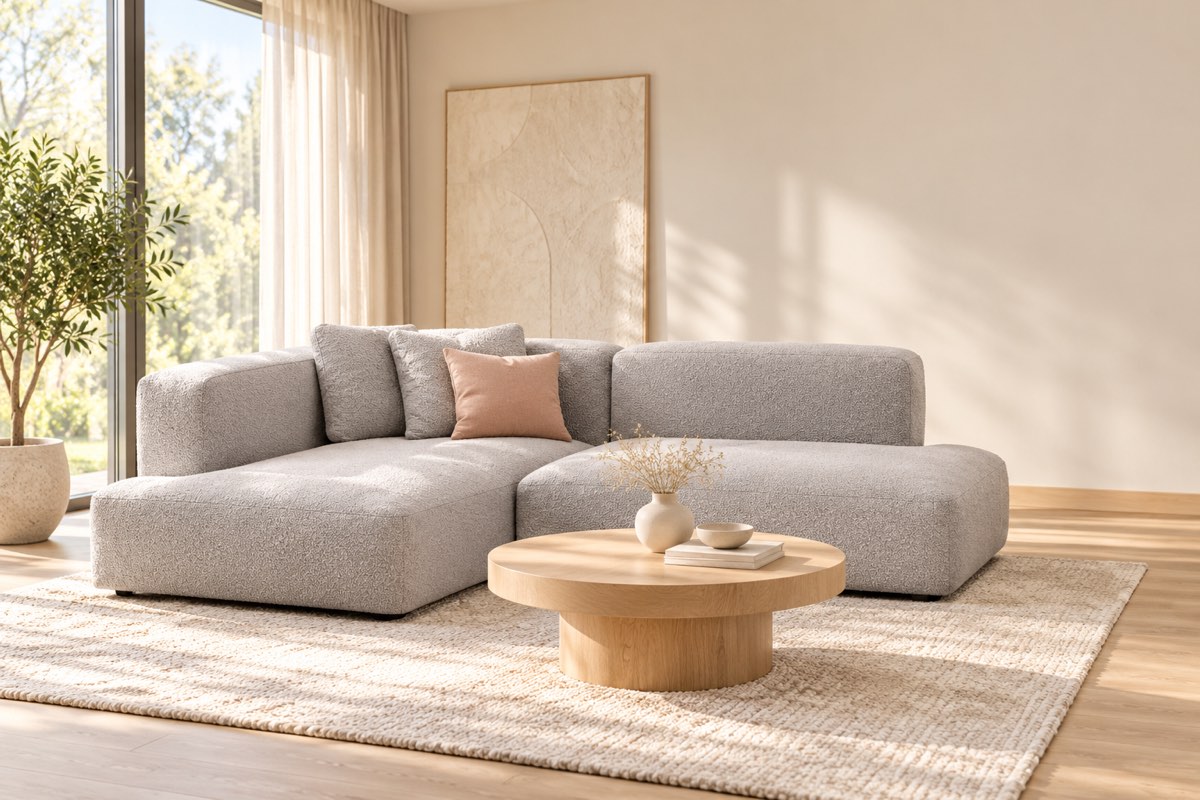
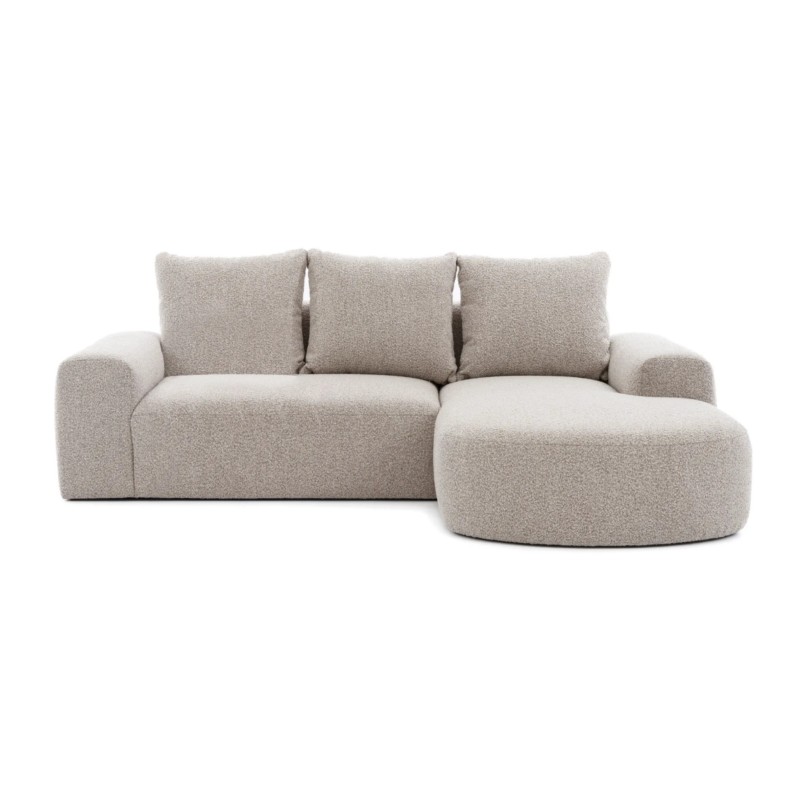
On our models the corner section extends from 149 to 410 cm. Bella Cloud is 149 cm, the Nordik corner sofa 212 cm, ELLENKA XL 410 cm. So a large corner sofa takes up not one wall but two, and the second can take up to four metres.
Measure both sides before ordering. And separately, whether there will still be a walkway. Between the corner of the sofa and a table or the opposite wall you need at least 70–80 cm; otherwise you'll have to move around the room sideways.
Three measurements to take at home
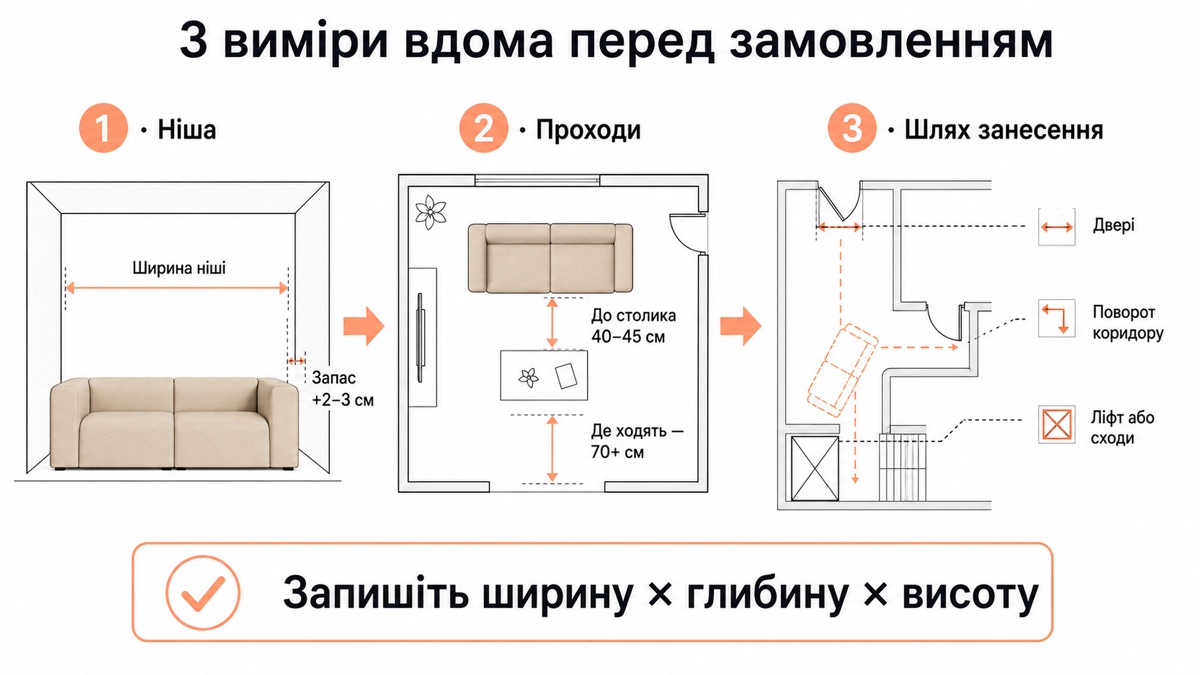
The recess where the sofa will go. Wall to wall, at the narrowest point. If the sofa fits snugly between walls, allow a 2–3 cm margin: walls are never perfectly parallel.
The walkway in front of the sofa. To a coffee table, 40–45 cm (so you can reach it without getting up). To a TV stand or wall, 70 cm or more if people walk there.
The route in. Doors, lift, the turn on the landing. This is the number one reason deliveries get rescheduled: the sofa fits in the room but won't go through the entrance. Modular models are carried in in parts, but you need to know about it in advance.
If no size fits
Dimensions aren't a fixed feature of a model but an order parameter. We change the length, depth and backrest height to fit your space. A 232 cm recess? We'll make 232, not 230.
And a sofa from a reference too. Send the manager a photo of a model you liked elsewhere, and our technologist will look at the construction and tell you what can be reproduced.
Read also: sofa size table and a sofa for the living room.
In brief
- Depth minus 15–20 cm = the real seat depth; over 80 cm is only for sitting with your legs up
- A backrest of up to 85 cm in a room of up to 16 m²; higher only against a wall and in a larger room
- 60 cm per seat, plus armrests
- With a corner sofa, measure both sides: the second extends from 149 to 410 cm
- Walkway: 40–45 cm to a coffee table, 70 cm or more where people walk
Standard sizes don't fit? We'll make a sofa to your dimensions.
Made-to-order sofa →