

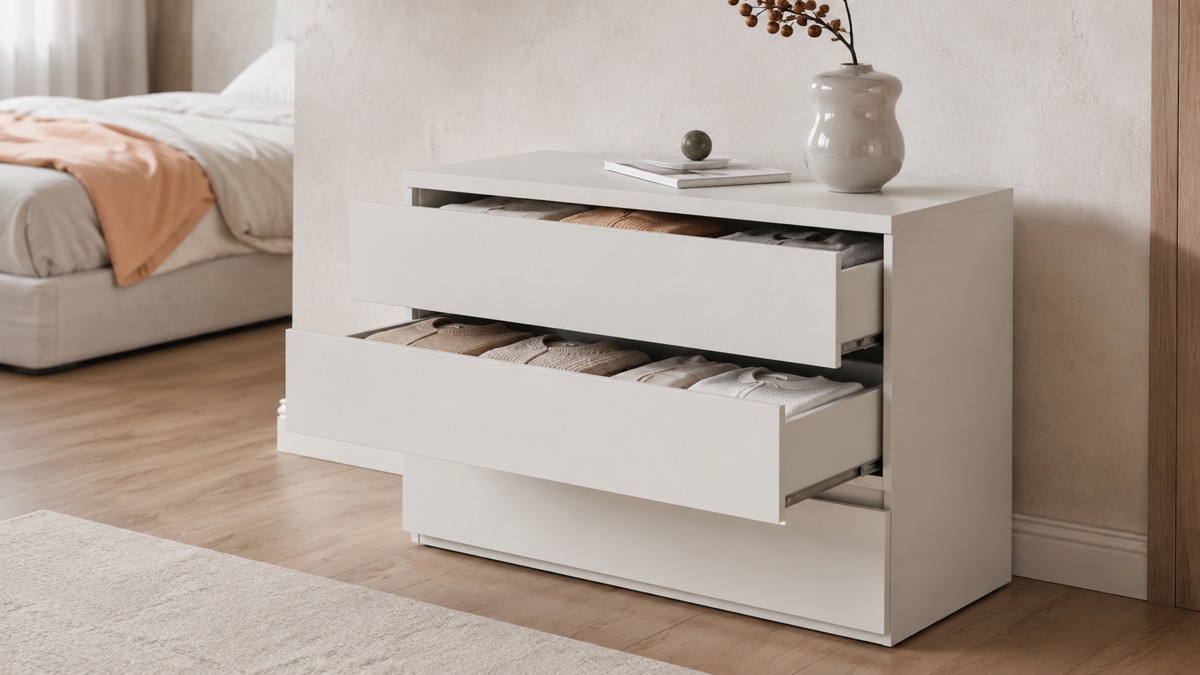
People choose a chest of drawers by its look and dimensions, and notice the number of drawers last. Yet that is what decides whether it will be convenient to use.
The main thing to understand
Total capacity depends on the dimensions, not the number of drawers. A chest of drawers 120 cm high holds the same whether it is divided into three sections or six; in the second case each one is simply half as deep.
So the question is not "how much space" but "how it is divided". And the answer depends on what you will put in it.
What fits in which depth
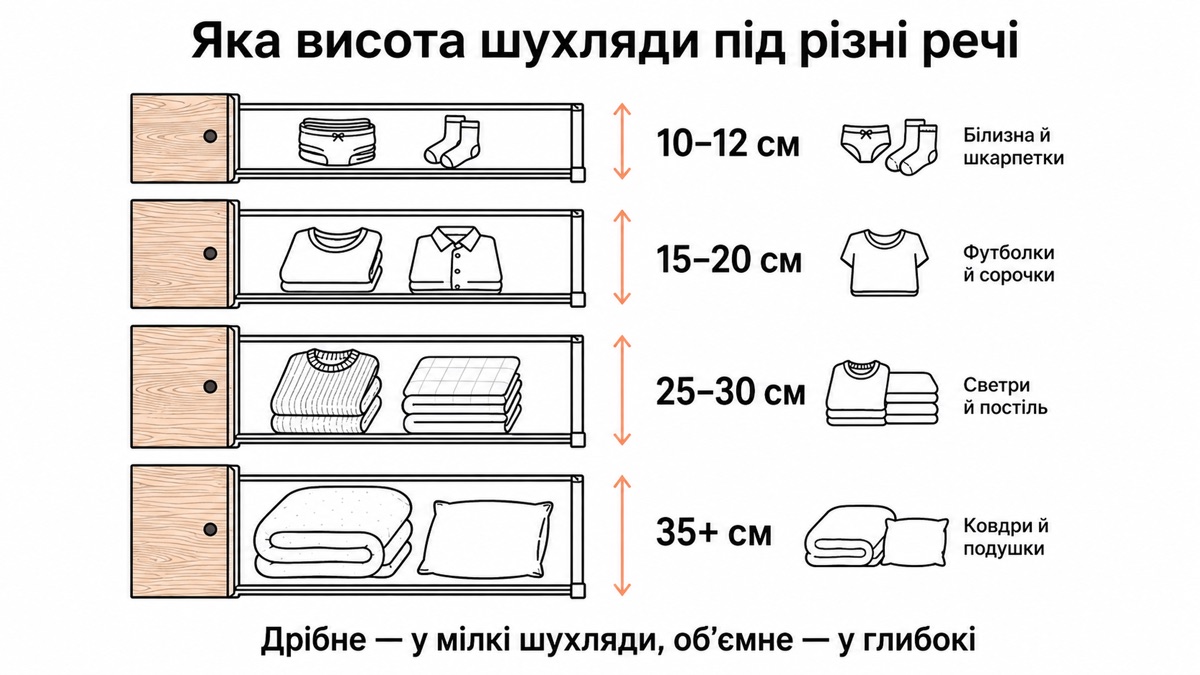
Practical drawer heights to start from:
- 10–12 cm: underwear, socks, small items. Deeper is worse for them: things sink in layers, and you don't reach the bottom ones for months.
- 15–20 cm: T-shirts, shirts, loungewear, folded.
- 25–30 cm: jumpers, sportswear, bed linen in sets.
- 35+ cm: duvets, pillows, seasonal items. At this point you need not a chest of drawers but a deep compartment or a top cupboard.
The rule that saves you: keep small things in shallow drawers and bulky things in deep ones. A chest with six identical drawers loses out to one where the top drawers are shallow and the bottom ones deep.
How many drawers our models have
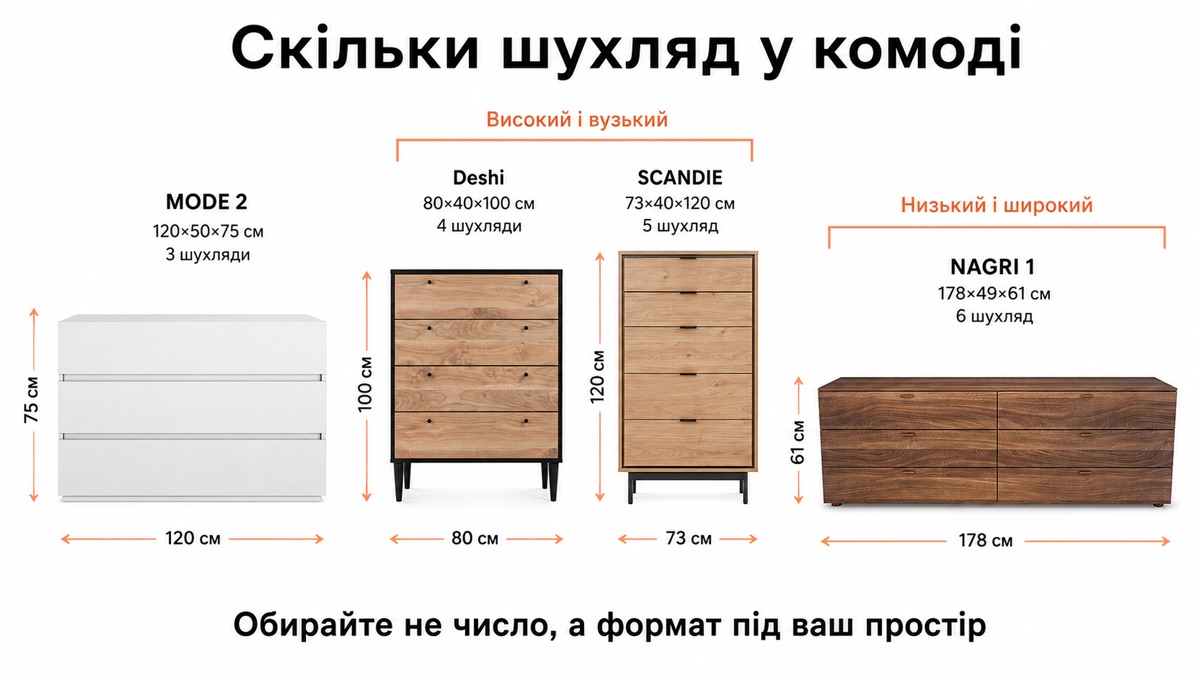
3 drawers: MODE 2 (120 × 50 × 75 cm). Each one is deep. This is a chest for bulky things: jumpers, bedding, children's clothes in bulk. It is inconvenient for small items; they get lost.
4 drawers: Deshi (80 × 40 × 100 cm). Narrow and tall, a classic Scandinavian format. A balance between section depth and number.
5 drawers: SCANDIE (73 × 40 × 120 cm). The narrowest in the range, with the greatest height: it takes up 0.3 m² of floor and gives five levels. In a tight bedroom it is often the only workable solution.
6 drawers: NAGRI 1 (178 × 49 × 61 cm). Here the logic is the opposite: the chest is low and very wide, so the six drawers are arranged in two rows of three. Each is shallow, and that is right, because a chest like this stands in the living room, where small things are kept and the top surface matters as much as what's inside.
Height versus width: two different pieces
Our range shows two opposite approaches, and they shouldn't be confused.
Tall and narrow: SCANDIE (120 cm), SOLID 1 (113 cm), Deshi (100 cm). Takes up minimal floor space and gives many levels. The downside: the top drawer is at a height of 100+ cm, it is awkward to look into, and it ends up holding things nobody needs.
Low and wide: NAGRI 1 (61 cm), VOK (80 cm), Deshi 2 (80 cm). Gives you a surface: TV, lamp, plants. Doesn't visually divide the room. The downside: it eats up the wall.
The comparison with a wardrobe is separate: chest of drawers or wardrobe: which for which room.
Three things people notice after buying
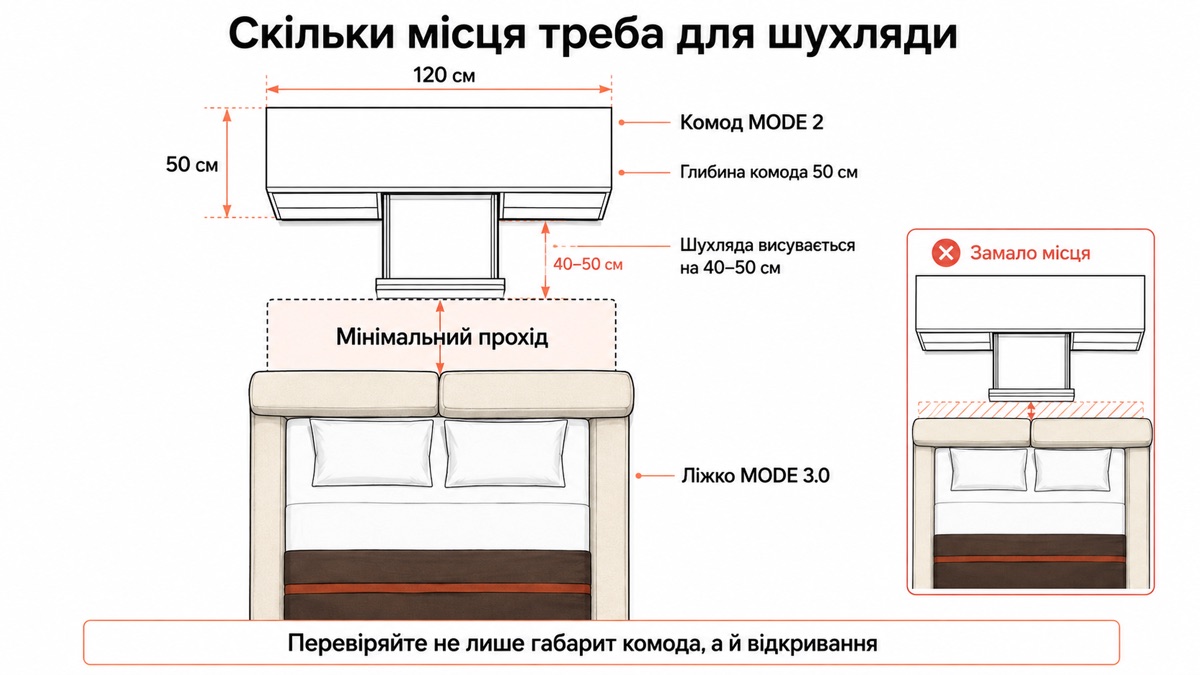
How much space you need to pull a drawer out. A drawer comes out 40–50 cm. If there is a bed or table opposite, work out this distance separately: the chest will fit, but it won't open.
Runners. These decide whether the chest will still be pleasant to use in three years. Our models use Hafele and Giff Prime; the point is not the brand but the fact that cheap roller runners start to stick when a drawer is loaded.
The top drawer in a child's room. If the chest is in a child's room, the child should be able to reach it on their own: that is the main advantage of a chest of drawers over a wardrobe. A tall chest takes that advantage away.
How many drawers you actually need
Instead of a universal answer, a simple count. Count the categories of things you need to keep apart: underwear, T-shirts, jumpers, bedding, small items. As many categories, as many sections, plus one.
It usually comes to four or five. Three is too few for a bedroom but enough if the chest is an extra. Six or more only makes sense in a wide, low format, where they are arranged in two rows.
Made for your space
A recess between a wardrobe and the wall, the space under a window, a specific height to match existing furniture: we make the dimensions and drawer layout to order. For a chest of drawers this is useful more often than you'd think: this is exactly where 10 cm decides whether it fits into the recess.
In brief
- Capacity is set by the dimensions; the number of drawers only decides how it is divided
- Shallow (10–12 cm) for small things, deep (25–30 cm) for bulky ones; identical drawers are the worse option
- 3 drawers for bulky items, 4–5 for general use, 6 only in a wide, low chest
- Count the categories of things: as many categories, as many sections, plus one
- A drawer comes out 40–50 cm: check what is opposite