

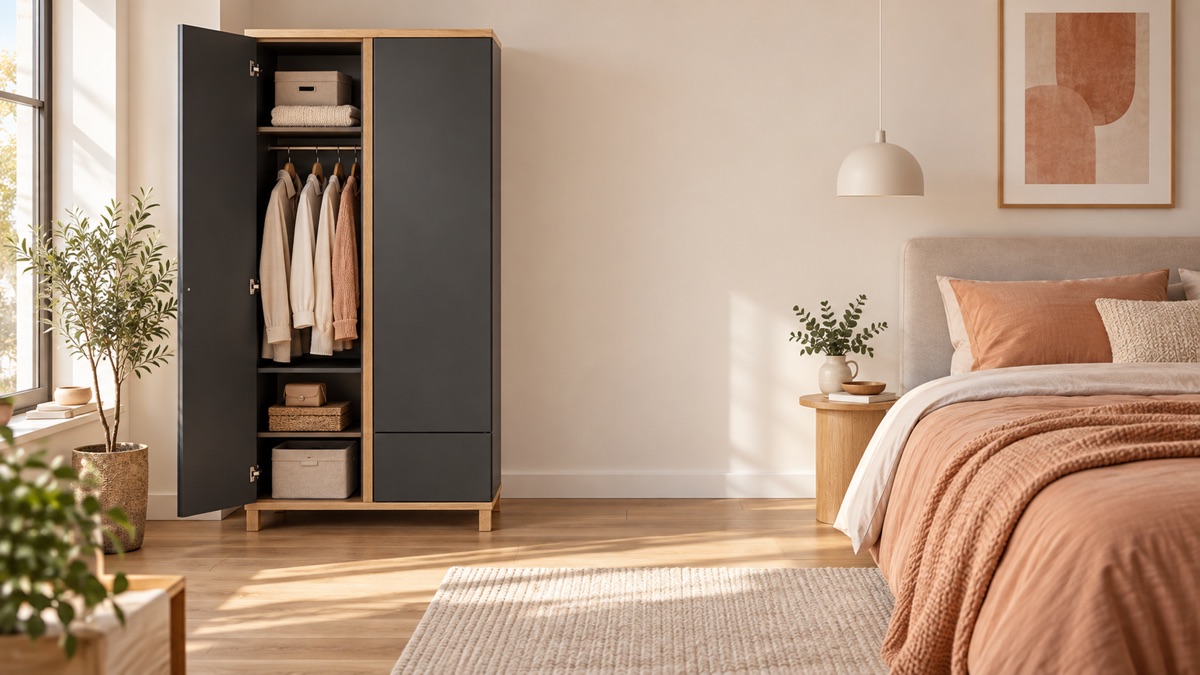
This is a rare case where the choice is made not by taste but with a tape measure. Measure the distance from the front of the wardrobe to the nearest obstacle: a bed, a wall, a table. That figure decides it.
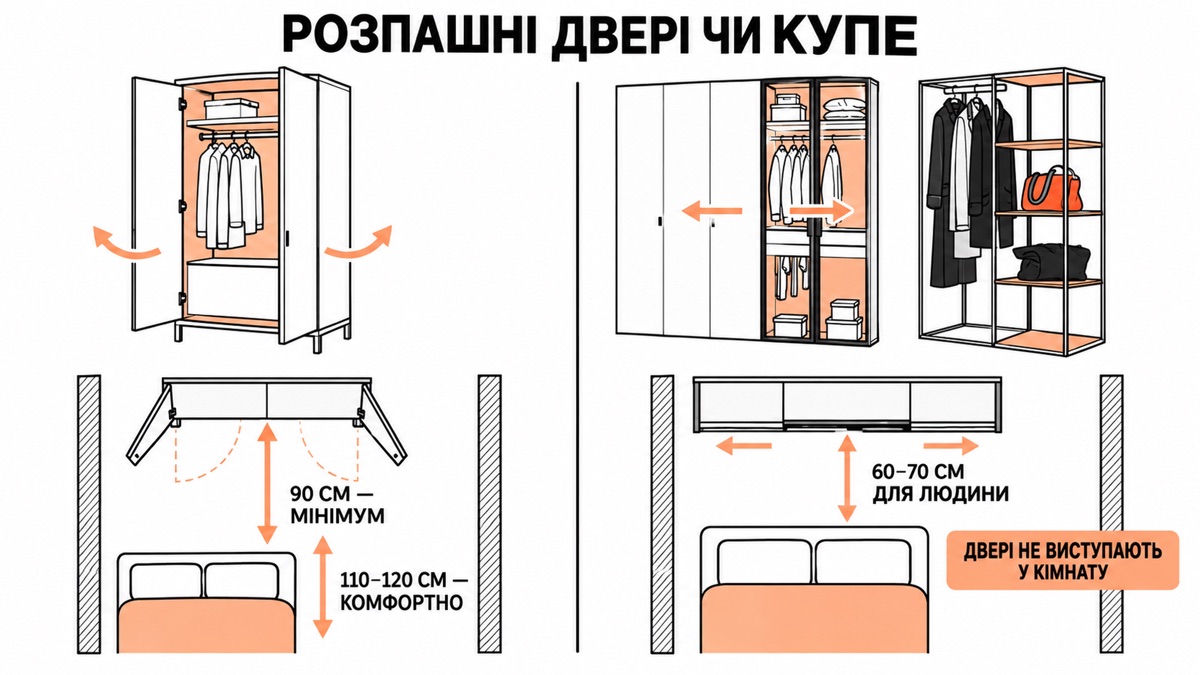
How much space hinged doors need
A door opens out by its own width. A 50 cm door sticks out 50 cm into the room. Plus room for you to stand in front of the open wardrobe and get things out.
The working minimum is 90 cm from the wardrobe front to the obstacle. That is a 50 cm door plus 40 cm for a person. It is tight, but it works.
Comfortable: 110–120 cm. Then you stand freely in front of the open wardrobe, not pressed against the bed.
Less than 90 cm and the doors will either hit the obstacle or not open fully. The second is worse: the wardrobe seems to work, but using it every day becomes a struggle.
How much a sliding wardrobe needs
None. That is the whole point: the doors slide along the front and nothing sticks out. A sliding wardrobe can be placed right next to the bed.
Space is only needed for a person: 60–70 cm to stand in front of the wardrobe.
That is its only advantage, but a decisive one.
What you pay for sliding doors
This is talked about less often, so point by point.
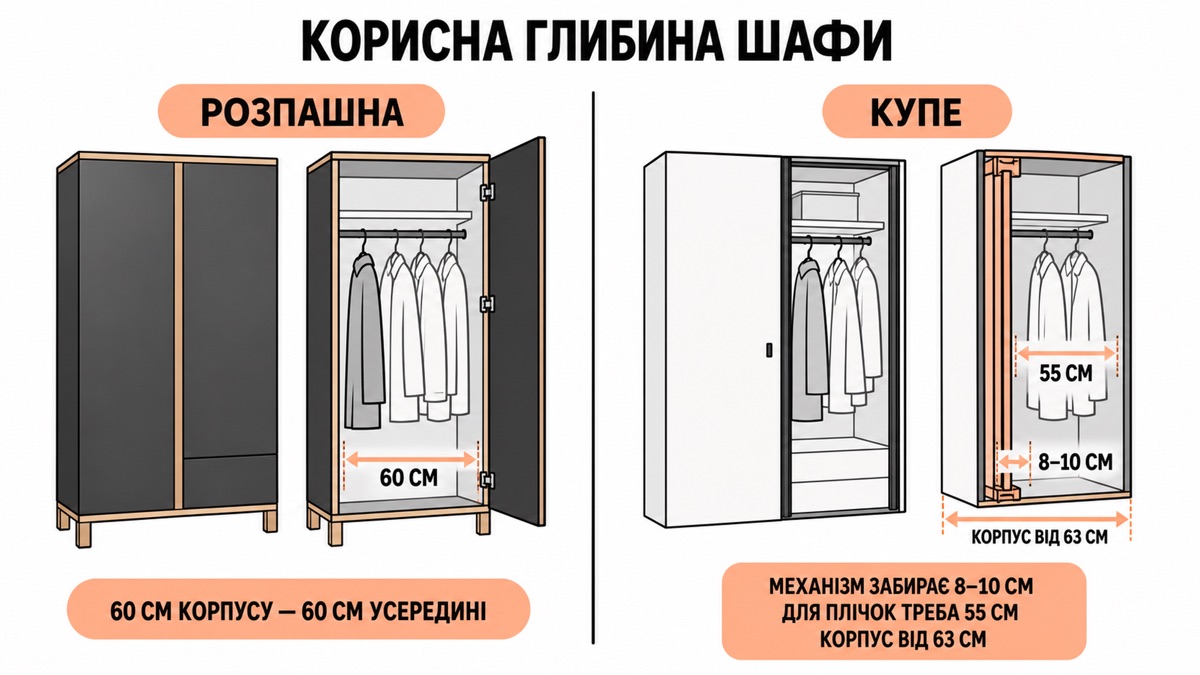
Loss of depth: 8–10 cm. The mechanism and tracks take up space inside. A 60 cm deep wardrobe with sliding doors gives 50 cm of usable depth, while hangers need 55. So a sliding wardrobe has to be deeper than a hinged one to hold the same. This is the most important and least obvious point.
Half the wardrobe is always closed. The doors slide behind one another, so you never see all the contents at once. A small thing, until you are looking for a particular item in the morning.
The mechanism wears. Rollers and tracks are moving parts with a limited life. The hinges of a hinged wardrobe are more reliable in this respect.
Dust in the tracks. The bottom rail collects dust and hair and needs cleaning; otherwise the doors start to slide stiffly.
What you pay for hinged doors
Space. That is the whole list, but in a small bedroom it is enough to settle the question.
In return you get: a full view of the contents, more usable depth, a simpler construction and doors that don't jam.
What our range offers
The catalogue has hinged and open models:
- Chill and Chill 2: 90 × 53 × 184 cm
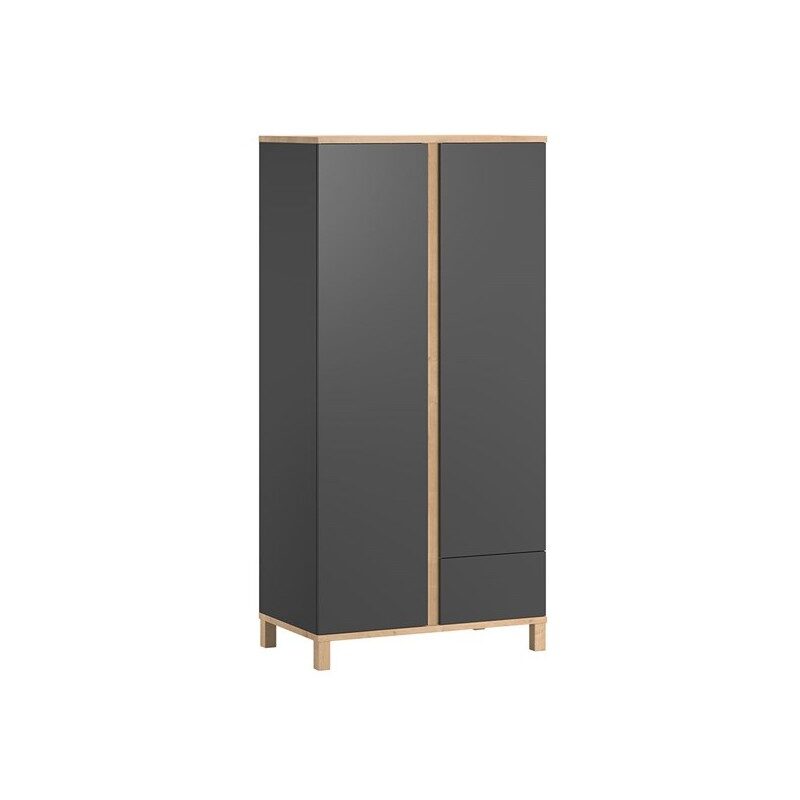
- Chill 3: 100 × 61 × 223 cm, two doors. A depth of 61 cm, the deepest in the range; hangers fit without question
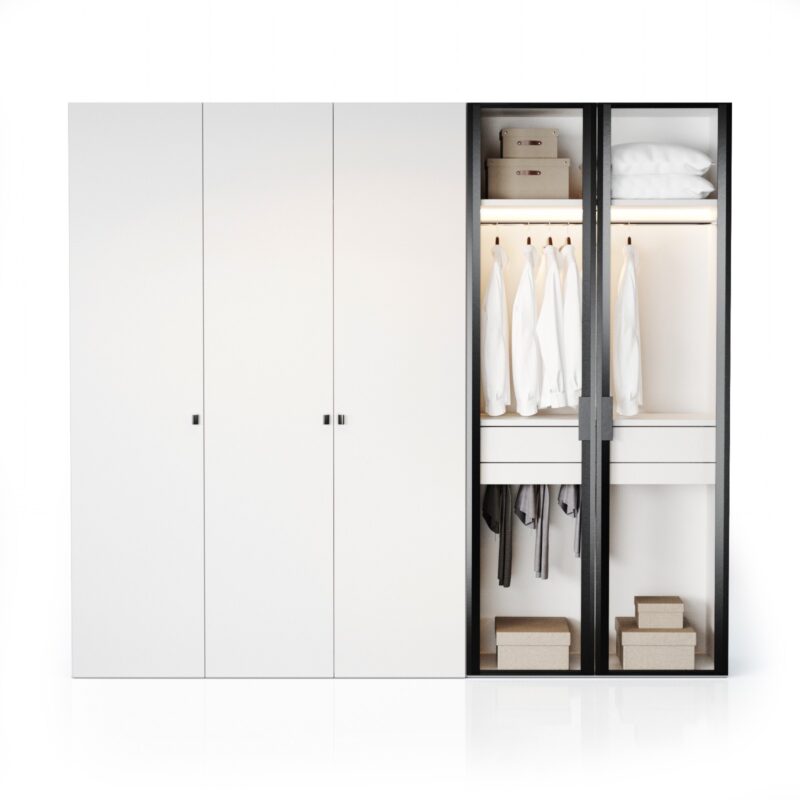
- MODE: 225 × 50 × 200 cm, five doors: three solid and two transparent in an aluminium frame with lighting
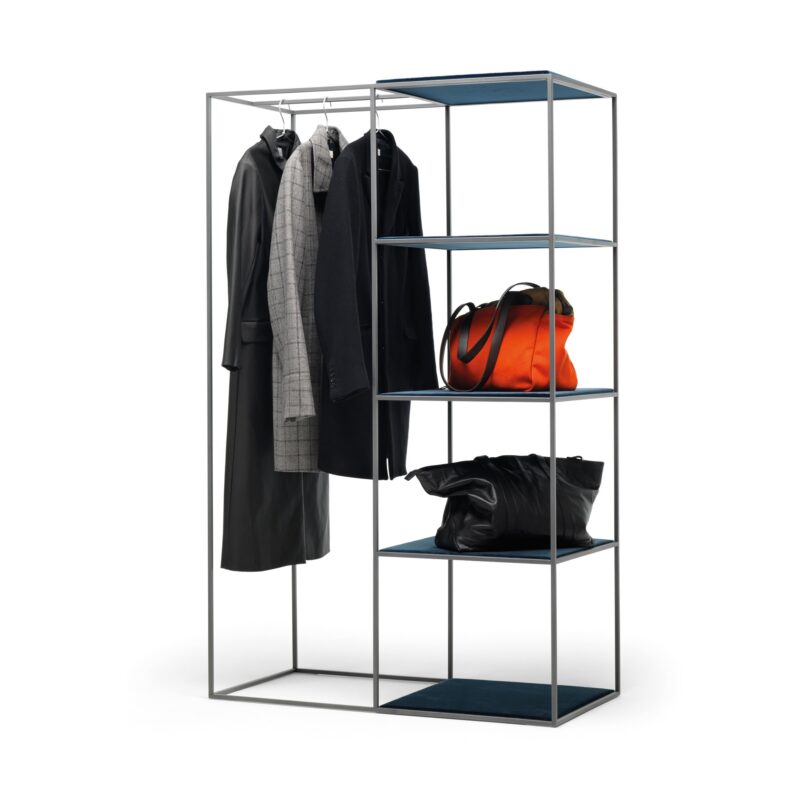
- Only: 104 × 54 × 170 cm, an open system on a metal frame, no fronts
- AMBER wardrobe-shelving unit: 104 × 170 cm, open
We make sliding wardrobes too, as custom orders. There are no such models in the catalogue, so if space in front of the wardrobe is tight, tell the manager: we'll price a sliding wardrobe for your recess.
How to decide in two minutes
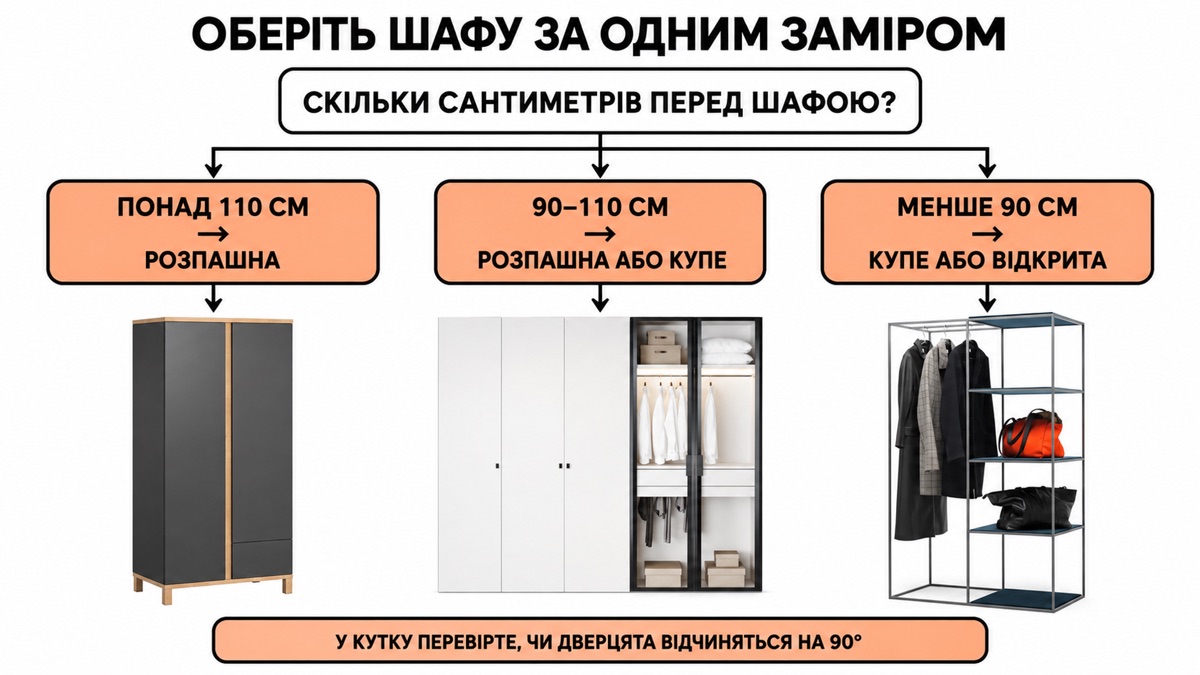
- Measure the distance from the future wardrobe front to the nearest obstacle.
- Over 110 cm: choose hinged. You gain nothing from sliding doors and lose depth and visibility.
- 90–110 cm: hinged will work, but it's a bit tight. Consider how often you use the wardrobe: if every day, sliding doors are better.
- Less than 90 cm: sliding doors only. Or an open system, if tidiness is in your nature.
A third option that often fits
Open storage. Only and AMBER have no fronts at all, so they need neither space for opening nor depth for a mechanism.
There is one condition: everything in them is always on view. This works if your wardrobe is small and orderly, and doesn't work if you have a lot of things. Assess yourself honestly, not your intentions.
A detail people notice after installation
Hinged doors have one more dimension nobody thinks about: they won't open to 90° if there is a wall next to them. A wardrobe in the corner of a room with its doors against the wall will open to about 60 degrees, and the end section becomes hard to reach.
So when planning, look not only at the distance in front of the wardrobe but also at what is next to it on each side.
A non-standard recess
A recess for a wardrobe is almost never a standard width, and this is exactly where 10 cm decides whether it fits or not. We make the width, depth and height to fit your space, with either hinged or sliding doors.
The comparison of a wardrobe with a chest of drawers is separate: chest of drawers or wardrobe: which for which room.
Read also: chest of drawers or wardrobe: which to choose and your dream walk-in wardrobe.
In brief
- Hinged: 90 cm to the obstacle is the minimum, 110–120 cm is comfortable
- Sliding: needs no space for opening, but eats 8–10 cm of depth inside
- Hangers need 55 cm of usable depth: with sliding doors that means a body from 63 cm
- The catalogue has hinged and open models; sliding wardrobes are made to order
- A wardrobe in a corner: the doors won't open fully, and the end section suffers
MeBelle wardrobes are made to your size and layout.
See wardrobes →