

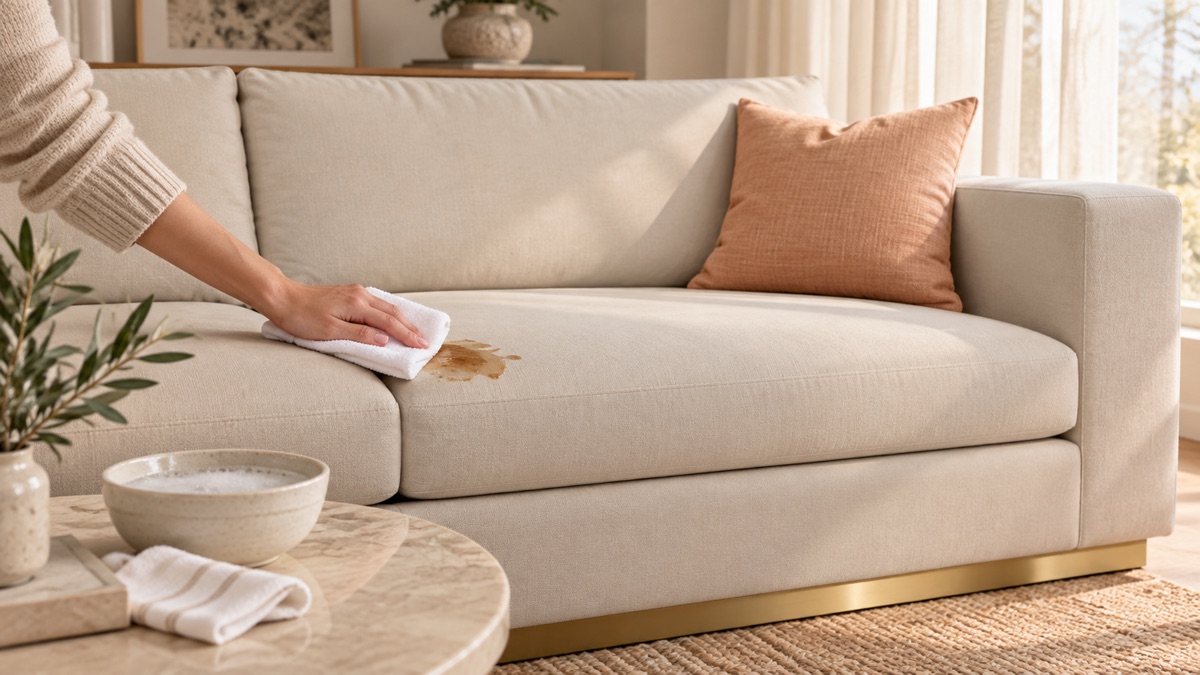
A fresh stain on a sofa is many times easier to remove than one that has had time to soak into the fibres and "dry in". Let's go through the steps for the most common kinds of stain — plus a quick guide on what to do with specific types.
The short answer
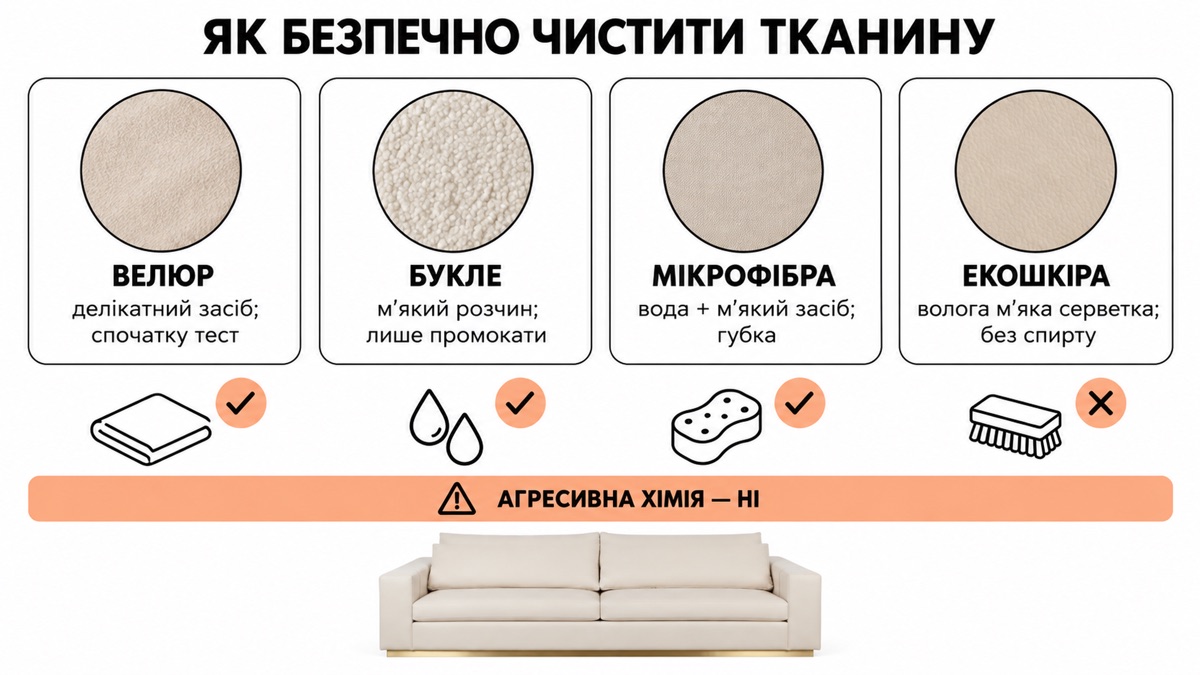
Blot a fresh stain with a dry cloth from the edges towards the centre — don't rub. After that, the method depends on the fabric: velour is cleaned in the direction of the pile with a minimum of water, basket-weave fabric and chenille with a sponge and no pressure, and eco-leather is simply wiped with a damp cloth — but no alcohol or solvents.
Step 1: the first sixty seconds
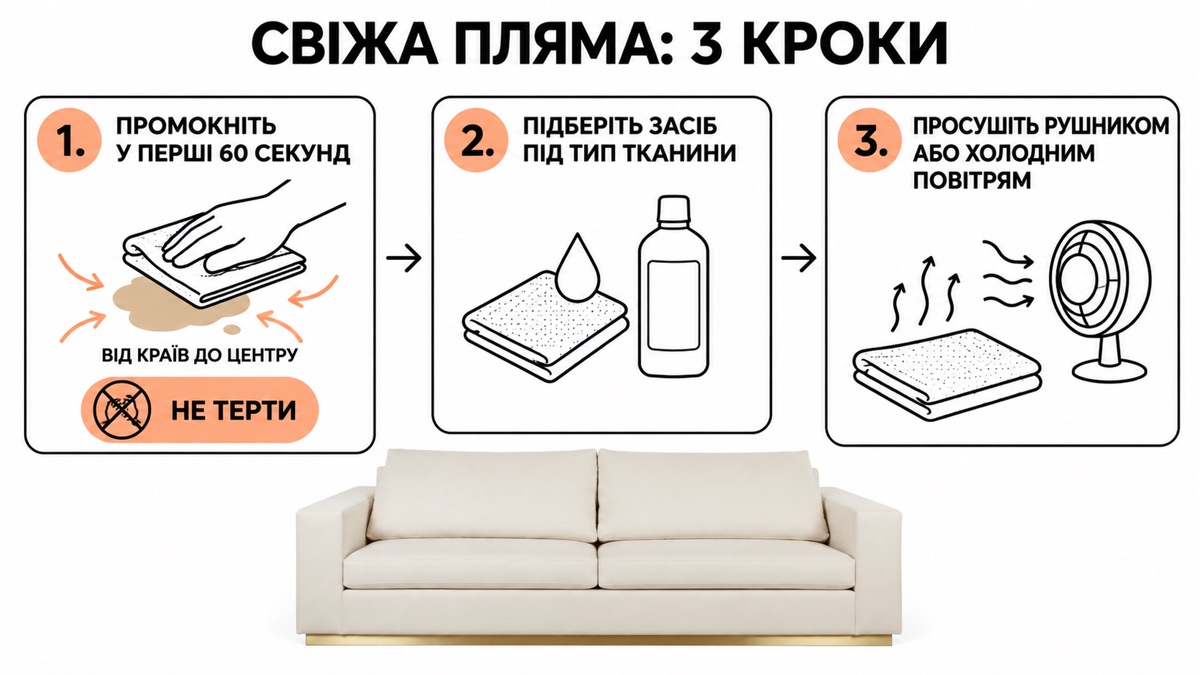
This is the step that decides everything else. A fresh stain and a half-hour-old stain are different problems, and the difference between them is bigger than between any two cleaning products.
If the stain is liquid (juice, coffee, wine), blot it with a dry napkin or towel, working from the edges towards the centre so you don't spread it over a larger area.
Don't rub. Rubbing does two harmful things at once: it drives the dirt deeper into the fibres and damages the surface itself — it raises the pile or pulls out a loop.
Keep blotting until the cloth stops picking up colour. Use as many cloths as it takes; most people stop too early, and what's left in the fibres later shows through again.
Step 2: the method depends on the fabric, not the stain
There's no universal "removes every stain" product, and the main reason isn't the stain itself but the structure of the fabric. Pile, looped and smooth surfaces behave differently with the same liquid.
Our furniture uses fourteen materials, and for care they fall into four groups.
Pile fabrics: velour, velvet, corduroy, Alcantara
The pile has a direction, and that's the main thing to know. Blot and clean in the direction of the pile, not against it and not in circles — otherwise you'll be left with a lighter or darker patch where the stain was, more noticeable than the stain itself.
Once it's dry, go over it with a soft brush in one direction to lift the pile. Often it's this step, not the cleaning product, that restores the look of the area.
Use a minimum of water. Pile fabrics take a long time to dry, and moisture left deep inside leaves tide marks around the edges of the drying area.
Looped fabrics: bouclé, basket-weave fabric (rogozhka), chenille
Never pull a loose loop and never scrub with a brush. This is the most important warning in the whole article: in bouclé the thread runs in loops, and one pulled loop turns into a snag across the whole piece. If a loop has come out, carefully tuck it back in with the blunt end of a needle, without cutting it.
Basket-weave fabric and chenille are more forgiving — the tight weave absorbs more slowly, so you have more time. You can clean them with a sponge, but without pressure.
Smooth synthetics: microfibre, woven fabric, corduroy LUX
The least demanding group. A solution of mild detergent and water, a sponge, then blot dry. Microfibre also dries quickly, so tide marks appear on it less often.
Leather-like: eco-leather, faux leather, vinyl leather, Arpatek
Liquid isn't absorbed at all — you simply wipe it off with a damp cloth. That's the whole advantage of these materials.
But there's a prohibition people learn too late: alcohol, acetone, solvents and products based on them destroy the coating. The mark they leave can't be removed — the surface goes dull and eventually cracks. Only water and mild detergent.
Separately: fabrics with a protective treatment
Here warm water without any product is often enough: the treatment has already stopped the liquid soaking in. The main thing is not to wait. A treatment gives you minutes, not hours. More — anti-vandal fabrics: myths and reality.
Don't know your fabric? It's listed in the product specifications under "Upholstery". If we made your sofa, the name of the collection is kept in the order, and our manager can tell you from the order number.
Step 3: dry it properly
After cleaning, dry the treated area with a towel or a hairdryer on a cool setting — moisture left deep in the fibres can cause an unpleasant smell or tide marks. Don't sit on the damp spot or cover it with a throw until the fabric is completely dry.
A quick guide by type of stain
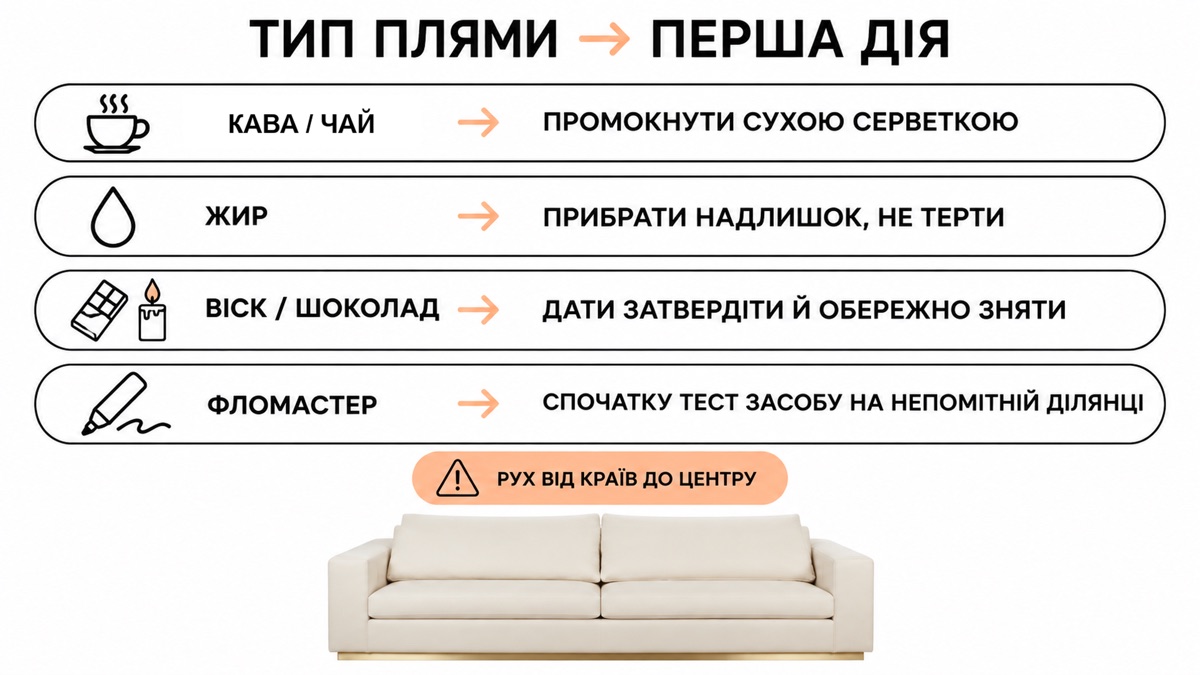
- Coffee, tea, juice — blot straight away, then treat the area with a soapy solution, working from the edges towards the centre.
- Grease stains — don't wet them straight away: first sprinkle the stain with salt or starch so the absorbent soaks up the grease, and only then clean with a solution.
- Chocolate or wax — let it harden and carefully lift it off with the blunt side of a knife, then treat what's left with a mild product.
- Pen or felt-tip marks — the trickiest: always test the product on an inconspicuous area, and if in doubt, it's better to go straight to professionals.
Old stains: you can't always manage without professional cleaning
If a stain dried several days ago, home methods can freshen up the area, but they can't always fully remove deep dirt. In such cases it's worth turning to professional cleaning, and regular home care will help prevent it happening again — we've collected five rules for it in the article "How to look after your sofa".
What not to do
- Leave the stain wet — moisture that takes a long time to dry encourages smells.
- Use harsh chemicals without testing them on an inconspicuous area.
- Scrub the stain with a brush — this spreads the dirt over a larger area of fabric.
Prevention: fewer stains
The best stain is the one that never happened. Vacuum the sofa once a week with a soft attachment, keep drinks on the table rather than on the armrest, and cover your favourite spot with a throw if there are children or pets at home. And when choosing a new sofa, look for fabrics with a protective treatment — they give you precious minutes to wipe up a liquid before it soaks in.
Read also: sofa care and fabric for a home with children and pets.
Frequently asked questions
Can I clean a sofa with bicarbonate of soda or vinegar?
Bicarbonate of soda works as an absorbent on dry and grease stains — that's safe. Vinegar is risky on coloured fabrics: it can change the shade, and the mark it leaves will be more noticeable than the stain. If you try it — only on an inconspicuous area and well diluted.
Can covers be washed in a washing machine?
It depends on the model. Not every sofa is designed with a removable cover, and those that can be removed have different washing settings. Ask our manager about the specific model — there's no universal answer, and a mistake costs you the cover: the fabric shrinks and won't stretch back on.
What if the stain has already dried?
First soften it with warm water and leave it for a few minutes, then treat it as a fresh one. Home methods will freshen up the area but don't always remove deep old dirt — in that case it's a reason for professional cleaning, not for stronger chemicals.
Can I use a steam cleaner?
On pile fabrics steam can flatten the pile; on leather-like ones it can damage the coating. If you do try it, keep the nozzle at a distance and start on an inconspicuous area.
The stain has gone, but a light ring is left. Why?
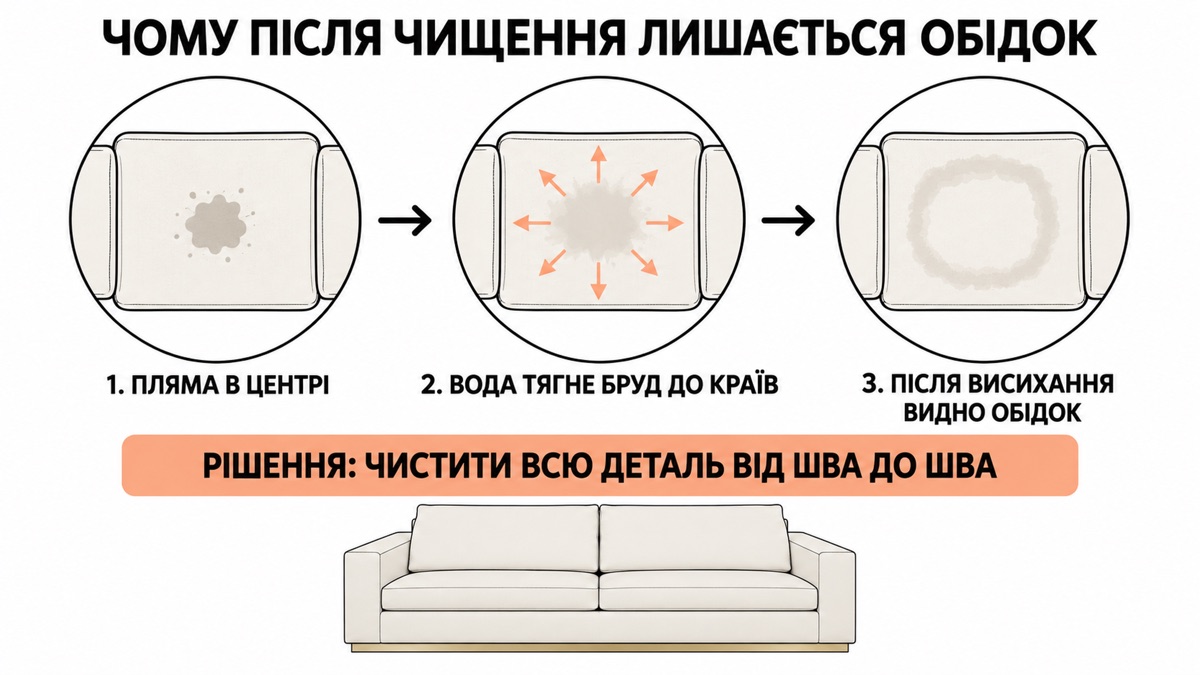
It's a drying mark: the water pulled the dirt to the edges of the treated area, where it settled. It's fixed by cleaning again — the whole panel, not just the stain — so there's no boundary between clean and not clean.
The cat has scratched the fabric — can that be cleaned?
No, that's no longer dirt. On tightly woven fabrics a snag can be tucked back in; on eco-leather a scratch can't be repaired. On choosing fabric for pets — a separate breakdown.
Kitchen chairs have their own nuances — how to clean an upholstered chair.
In short
- The first sixty seconds matter more than any product — blot straight away.
- Clean pile fabrics in the direction of the pile, looped ones without a brush and without pressure.
- No alcohol or solvents on eco-leather: the mark can't be removed.
- Blot a fresh stain from the edges to the centre — never rub.
- Choose the product for the fabric type and test it on an inconspicuous area.
- Sprinkle grease stains with salt or starch first instead of wetting them.
- Always dry the treated area after cleaning.
- Old, deep stains are a reason for professional cleaning, not harsh chemicals.


Planning a new sofa? Choose a model with a practical fabric that's easy to look after.
Go to the sofa catalogue →