

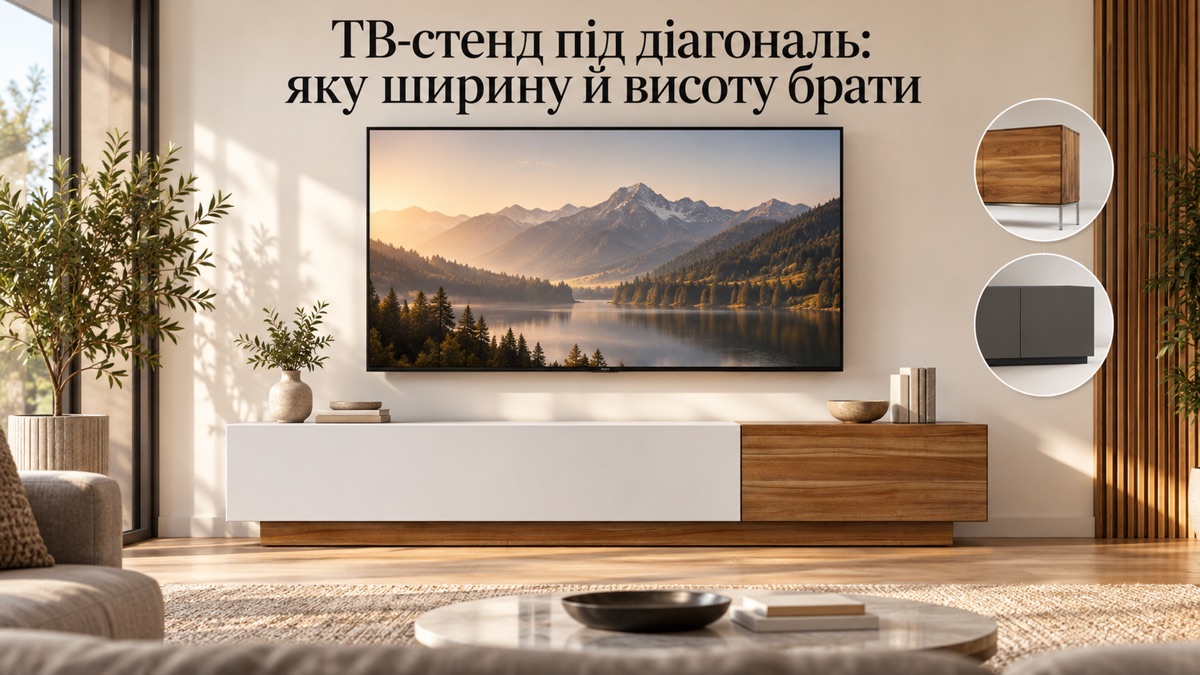
People choose a TV by screen size and a TV stand by looks. That leads to the most common mistake: the TV is wider than the stand, its feet hang over the edge, and the whole thing looks wobbly even when it's perfectly stable.
Let's go through the three dimensions one by one — width, height and depth. Width sets the look, height sets the comfort, and depth decides whether the TV fits at all.
Width: converting inches into centimetres
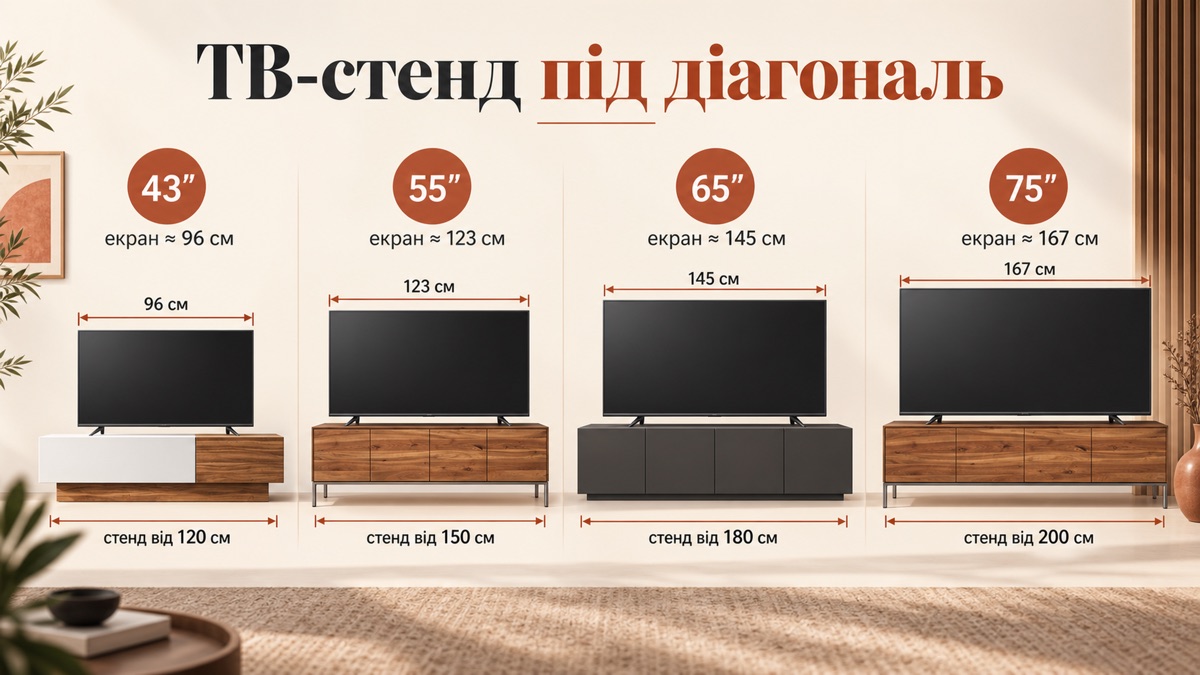
A diagonal in inches tells you nothing about width directly. For a standard 16:9 screen, the TV body is roughly 2.2 times wider for every 10 inches of diagonal. In practice:
| Screen size | TV width | Minimum stand | Comfortable stand |
|---|---|---|---|
| 43" | ≈ 95 cm | 100 cm | 120 cm |
| 50" | ≈ 111 cm | 120 cm | 145 cm |
| 55" | ≈ 122 cm | 130 cm | 160 cm |
| 65" | ≈ 144 cm | 150 cm | 180 cm |
| 75" | ≈ 166 cm | 175 cm | 200 cm |
| 85" | ≈ 188 cm | 200 cm | 220 cm |
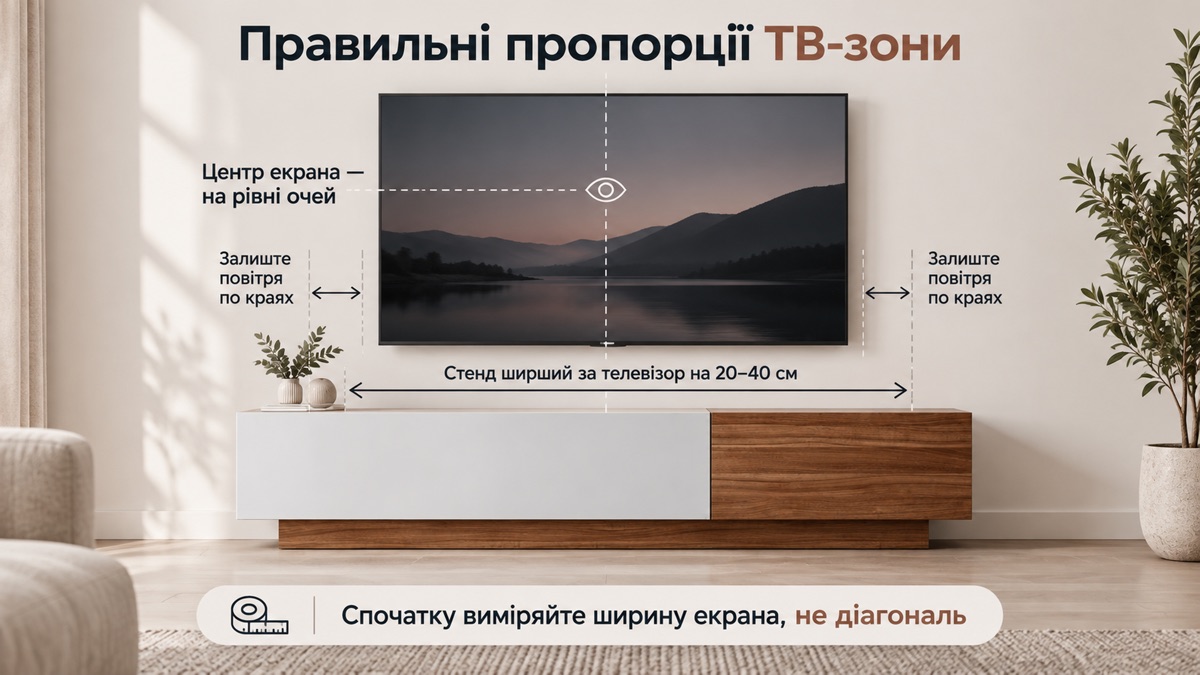
Minimum means the TV simply doesn't overhang. Comfortable means 15–20 cm of free top on each side. The visual difference is big: in the first case the stand looks like a pedestal, in the second — like furniture.
Our range comes in steps of width: 120, 145, 160, 180, 200 and 220 cm. So there's a size for any screen from 43 to 85 inches — Chill 2 at 120 cm for a small TV, VANITY at 220 cm for 85 inches.
Height: where the centre of the screen ends up
This rule gets mentioned less often than width, although it affects everyday comfort more: the centre of the screen should be roughly at the eye level of a seated person. That's 100–110 cm from the floor for a sofa of standard height.
It's easy to work out: stand height + half the TV height + 5 cm for the TV's own base. For 55 inches (body height about 69 cm) it looks like this:
- A 40 cm stand — centre at 79 cm. You'll be looking down.
- A 45 cm stand — centre at 84 cm. Acceptable, but still low.
- A 55–56 cm stand — centre at 94–95 cm. Close to right.
- A 67 cm stand — centre at 106 cm. Exactly at eye level.
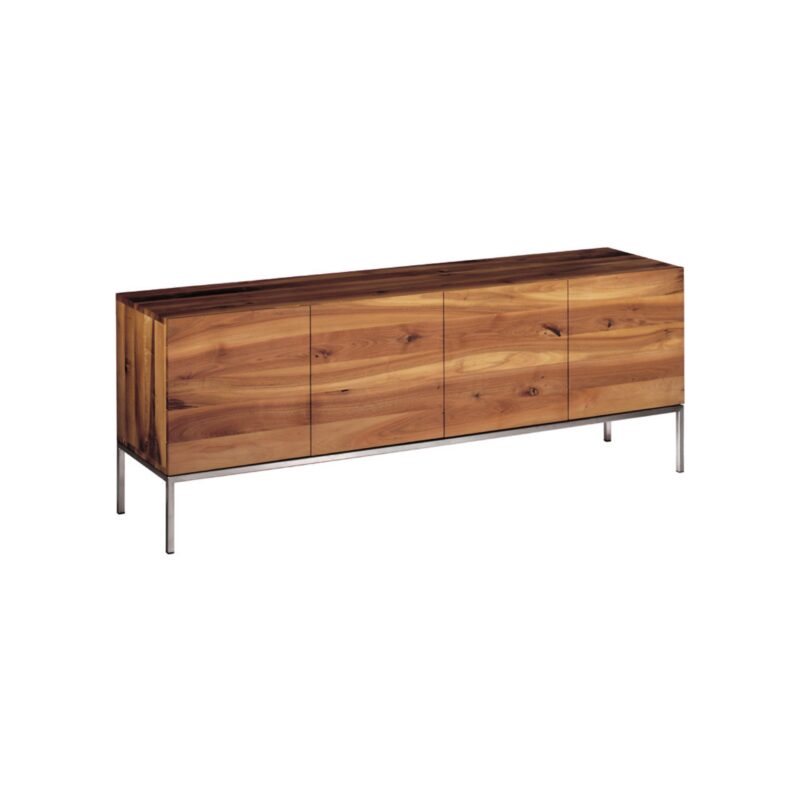
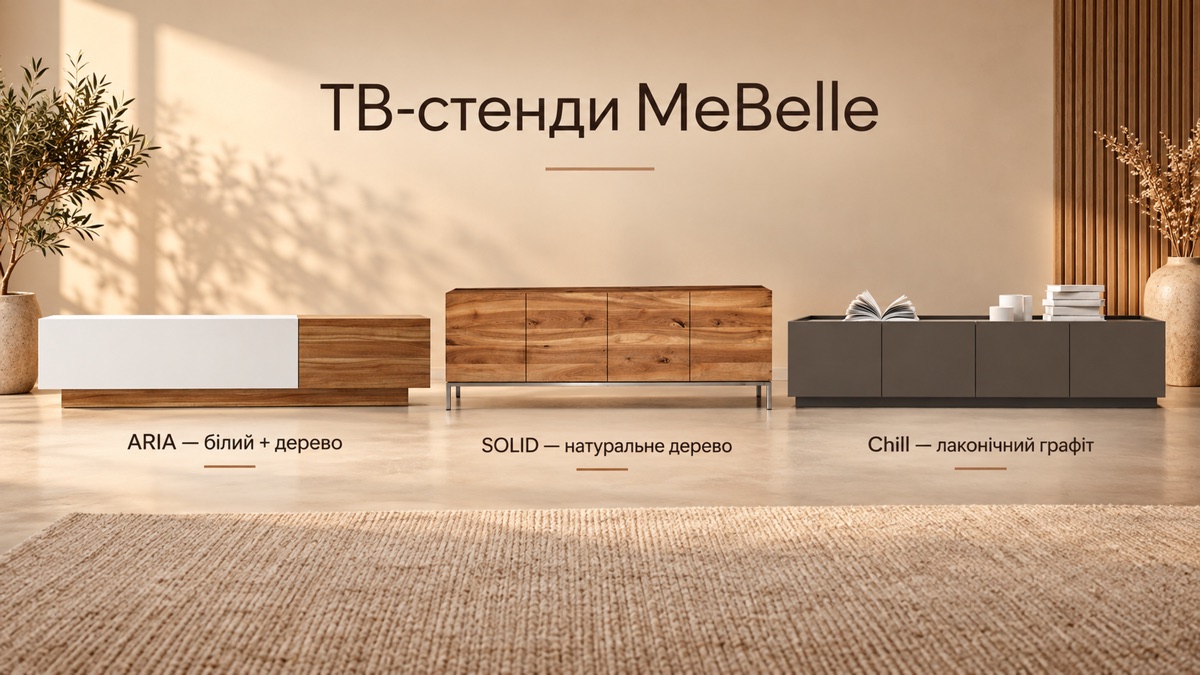
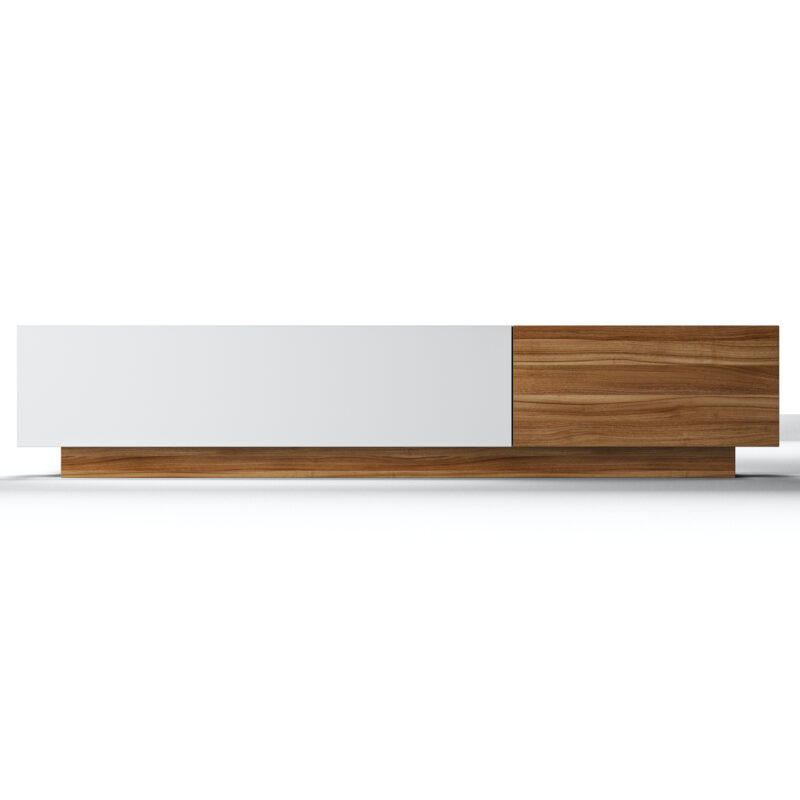
Heights vary across the range too: 40 cm for ARIA and Chill 2, 45 cm for AMBER and WOK, 50 cm for Chill and VANITY, 55–56 cm for ELEGY WHITE and SCANDIE, 67 cm for SOLID.
The practical takeaway. The bigger the screen, the lower the stand should be — a large TV "gains" height on its own. Tall models make more sense for 43–50 inches, low ones for 75–85.
Depth: the dimension that kills the purchase
Depth is remembered last, yet it's the one that most often becomes a problem — because TVs stand on two different types of base.
Two feet at the edges. They're narrow, and 30 cm of depth is more than enough. But check the distance between the feet against the stand's width — on large TVs the feet sit almost at the full width of the body.
A central pedestal. Its base is a solid plate, usually 25–30 cm deep. On a 30 cm deep stand it will fit edge to edge, with no margin at the front or back. For a TV like this, take at least 38–40 cm.
Our depths range from 30 cm (Chill 2) to 50 cm (VANITY), with most models at 38–40 cm. That's a universal size: it suits both types of base and leaves room for a set-top box or soundbar in front of the screen.
Details people notice after installation
Cables. A TV means at least three wires: power, aerial or internet, and often HDMI to a set-top box. If the stand goes flush against the wall, think ahead about where they will run.
Soundbar. It adds 6–8 cm of height and sits in front of the screen. If you're planning one, that's another argument for 40+ cm of depth and for not choosing a stand that's only just wide enough.
Lighting. An LED strip under the stand changes how the room looks in the evening more than you'd expect: the stand seems to "float" and a dark wall stops feeling heavy. We have it on ELEGY WHITE and on the 2 m ARIA.
Legs. Hidden plastic legs (AMBER, VANITY) make the stand look like a single solid volume — good for minimalist interiors. Metal legs (SCANDIE, SOLID, WOK) lift it off the floor: you can see the floor underneath, the room feels more spacious and it's easier to clean under. Solid ash legs (DESHI) are the warm option for Scandinavian interiors.
A stand or a wall-mounted TV?
If the TV is on a bracket, you still need a stand — for the set-top box, console and router. But the requirements change:
- The width can be anything — it's no longer tied to the screen size but to the proportions of the wall. A stand narrower than the TV looks odd; better to take at least the same width.
- Height no longer matters for viewing — choose it for easy access to the equipment.
- Depth can be smaller: 30 cm is enough for a set-top box and a router.
If you need a size that isn't in the range
A recess for a stand is rarely a multiple of 20 centimetres. If you have 172 cm between the wall and the door, that's no reason to take 160 and put up with the gap.
We make the width, depth and height to your size. It's a regular order, not a separate service: we take the design of a catalogue model and change its dimensions.
We also make stands from a reference. Send our manager a photo or a link to a model you liked elsewhere — our technologist will look at the construction and tell you what can be reproduced.
Read also: where to hide TV cables and a chest of drawers or a wardrobe.
In short
- The stand should be no narrower than the TV; for comfort, add 15–20 cm on each side
- The centre of the screen — 100–110 cm from the floor; the bigger the screen, the lower the stand
- 30 cm deep — only for feet at the edges; for a central pedestal take 38–40 cm
- Planning a soundbar — allow 40+ cm of depth
- Non-standard recess — we'll make the stand to fit it
MeBelle TV stands — for any screen size and any wall.
TV stands →