

Everything has been written about double beds: 160 or 180 is the eternal question. About kids' beds too: there is a guide by age.
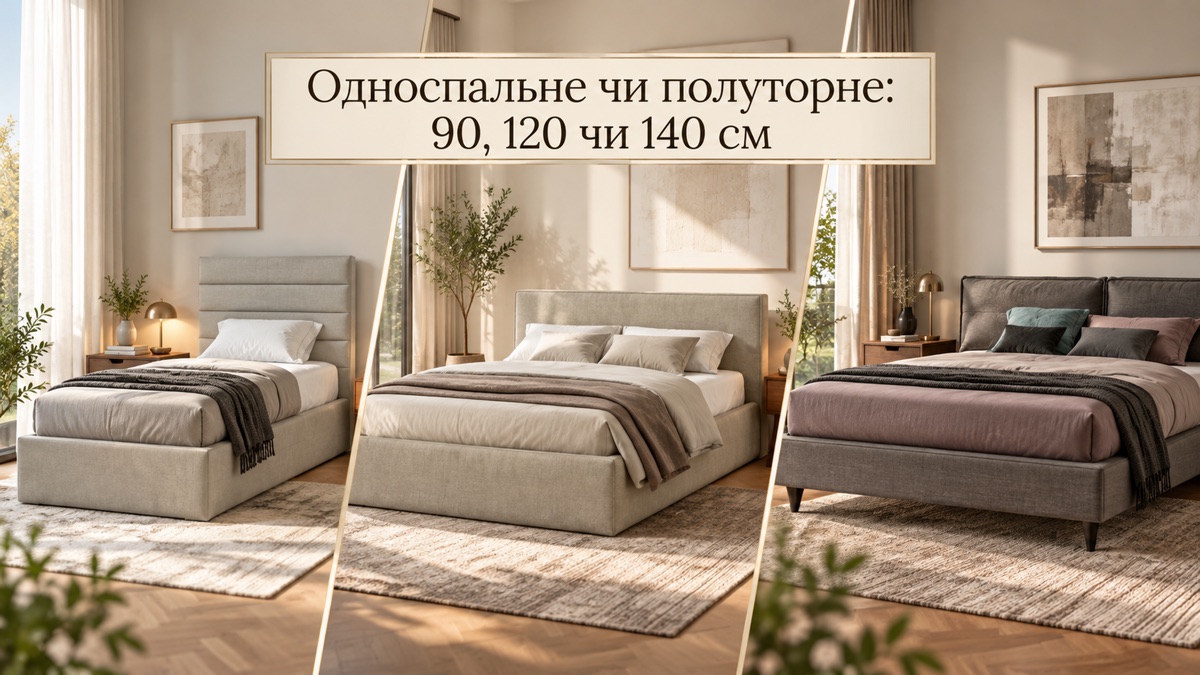
But in between there is a gap where people get lost. A 90 single? A 120 small double? Or straight to 140, which is "almost a double"? Let's go through the four widths one by one.
First, the length
Width is a choice. Length is a norm, and people get it wrong more often.
The minimum length for an adult bed is 190 cm. This isn't a recommendation but a limit below which a sleeping place stops being an adult one. For people up to 180 cm tall, a 190 cm bed works fine; above 180 cm, choose 200.
In our range every width comes in both lengths. The price difference between 190 and 200 is small, and the difference in comfort for a tall person is felt every night.
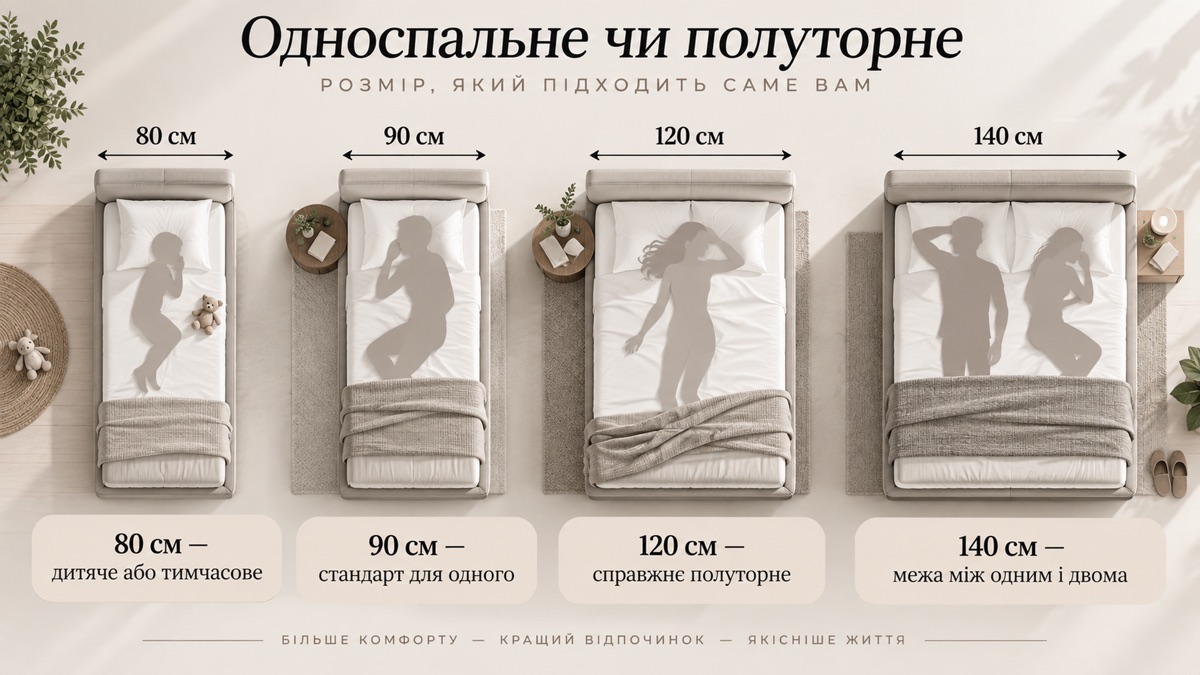
80 cm: only for children, and only for a while
This is a children's format. An adult will sleep on 80 cm but won't rest: to turn over you have to control the movement, and that stops you relaxing.
We have 80 cm in three lengths: 160, 190 and 200 cm. The 80 × 160 option is squarely a room for a small child. 80 × 190 and 80 × 200 suit a teenager, but as a size "to grow into" it is a dead end: the width will be too small while the length is still enough.
90 cm: the classic single
The most common single-bed standard. We have 16 models in 90 × 190 and 11 in 90 × 200.
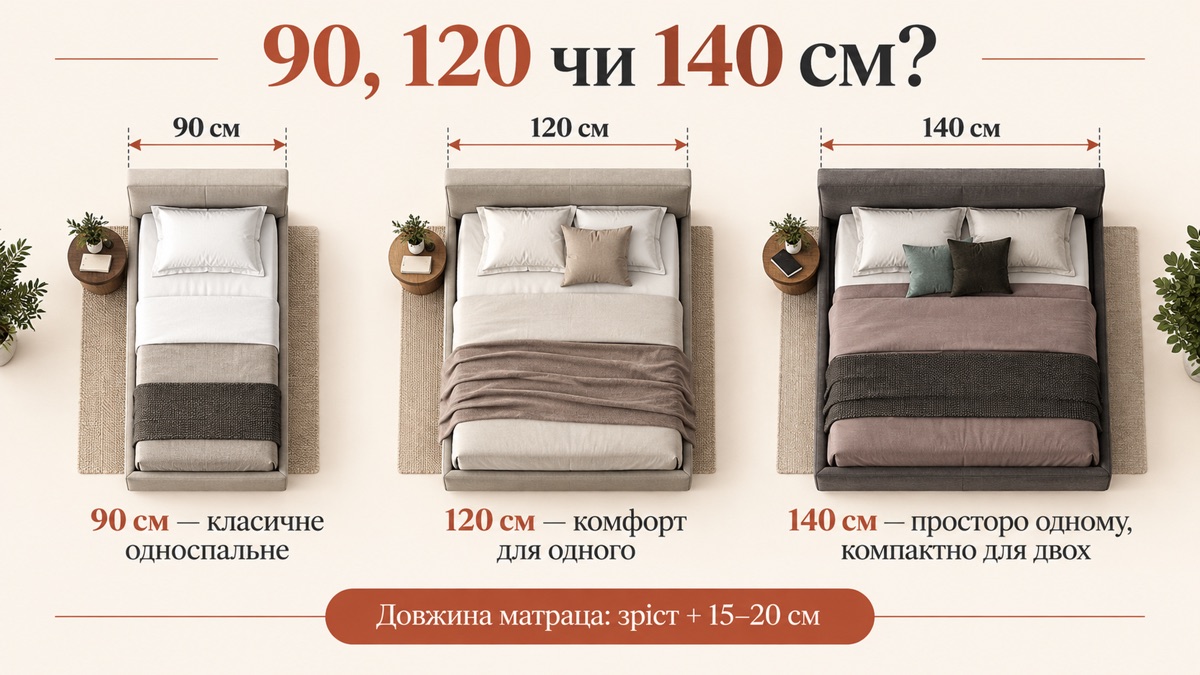
Who it suits. A teenager, a student, an adult in a small room, a guest bedroom. Ninety centimetres is the width on which an adult sleeps normally: you can turn over without thinking about the edge.
What it doesn't give you. Space. You sleep, but you don't sprawl. For most people that doesn't matter until they try something wider.
How much room it takes. With a 60 cm walkway on one side, 150 cm of room width. That fits practically anywhere.
100 cm: the size nobody asks about
And they should. This is the most widely available width in our range: 18 models in 100 × 200. More than in 90 and 140.
The reason is simple: a hundred centimetres is where a single bed stops being spartan. Ten centimetres over the standard are barely noticeable in the room but very noticeable at night: there is a margin at the sides, and you no longer have to sleep "in the middle".
Who it is the best solution for. An adult who sleeps alone and doesn't have room for 140. A teenager for whom 90 is already a bit tight. A guest room where you want your guest to get a good night's sleep, not just get through the night.
Why people don't know about it. Because in the popular mind there is the "90 single" and the "140 small double", with supposedly nothing in between. We have it, and it is the quietest piece of advice in this article.
120 cm: a small double in the literal sense
17 models in 120 × 200 and 5 in 120 × 190.
For one person this is already comfort. On 120 cm an adult doesn't just sleep but has space: you can lie diagonally, put a laptop or a book beside you and not feel the edge.
For two, only as an exception. A hundred and twenty for two is 60 cm per person, narrower than a single bed each. You can sleep that way for one night, not every day.
Who it suits best. An adult in a room of 10–14 m², where 140 is already cramped and 90 feels like a waste. And an older teenager: it is a bed that won't need replacing when they move into a flat of their own.
140 cm: the line where "for two" begins
10 models in 140 × 200 and 3 in 140 × 190.
For one person it is luxury. You no longer think about the edges at all. If the room allows and you sleep alone, it is the best of the four options.
For a couple, a compromise that doesn't always work. 70 cm per person. That is less than a single bed, and you feel your partner's movements. If 160 cm fits in the room, choose 160: the price difference is smaller than the difference in comfort.
When 140 for a couple is justified. When there's no other way to fit. A 140 bed plus two 60 cm walkways is 260 cm of room width. For 160 you already need 280.
A comparison in one table
| Width | For one | For two | Minimum room width* | Our models |
|---|---|---|---|---|
| 80 cm | only for a child | no | 200 cm | kids' range |
| 90 cm | fine | no | 210 cm | 16 (×190) / 11 (×200) |
| 100 cm | comfortable | no | 220 cm | 18 (×200) |
| 120 cm | spacious | as an exception | 240 cm | 17 (×200) / 5 (×190) |
| 140 cm | luxury | a compromise | 260 cm | 10 (×200) / 3 (×190) |
* bed width plus 60 cm walkways on both sides. If the bed stands against a wall, no walkway is needed on that side: subtract 60 cm.
Three mistakes to avoid
Choosing 140 "so two can sleep there sometimes". If two people will sleep there rarely, a guest mattress or a sofa bed will solve it more cheaply. If often, 140 is too small, and within a year you'll admit it.
Choosing 90 because it's "standard". Standard isn't a recommendation, just the most common figure. Measure the room: 100 or 120 often fits without losing anything.
Forgetting about the mattress. The bed width is the overall dimension. The mattress is bought to fit the inner size of the sleeping area, and it needs checking against the specifications of the specific model, not the name of the size.
If you need a width that isn't in the range
A 132 cm recess is no reason to take 120 and leave ten centimetres of empty space. We make the width, length and height to your size; it is a normal order.
And a bed from a reference too. Send the manager a photo of a model you liked elsewhere, and our technologist will look at the construction and tell you what can be reproduced.

Read also: how to choose a bed and a double bed: 160 or 180.
In brief
- A length of 190 cm is the limit for an adult bed; if you are over 180 cm tall, choose 200
- 90 cm is the working standard; 100 cm is the same standard with a margin
- 120 cm is spacious for one, for two only as an exception
- 140 cm for a couple is only justified when 160 doesn't fit in the room
- Measure the room: bed width plus 60 cm for each walkway
Any MeBelle bed can be ordered in the width you need.
Beds →