

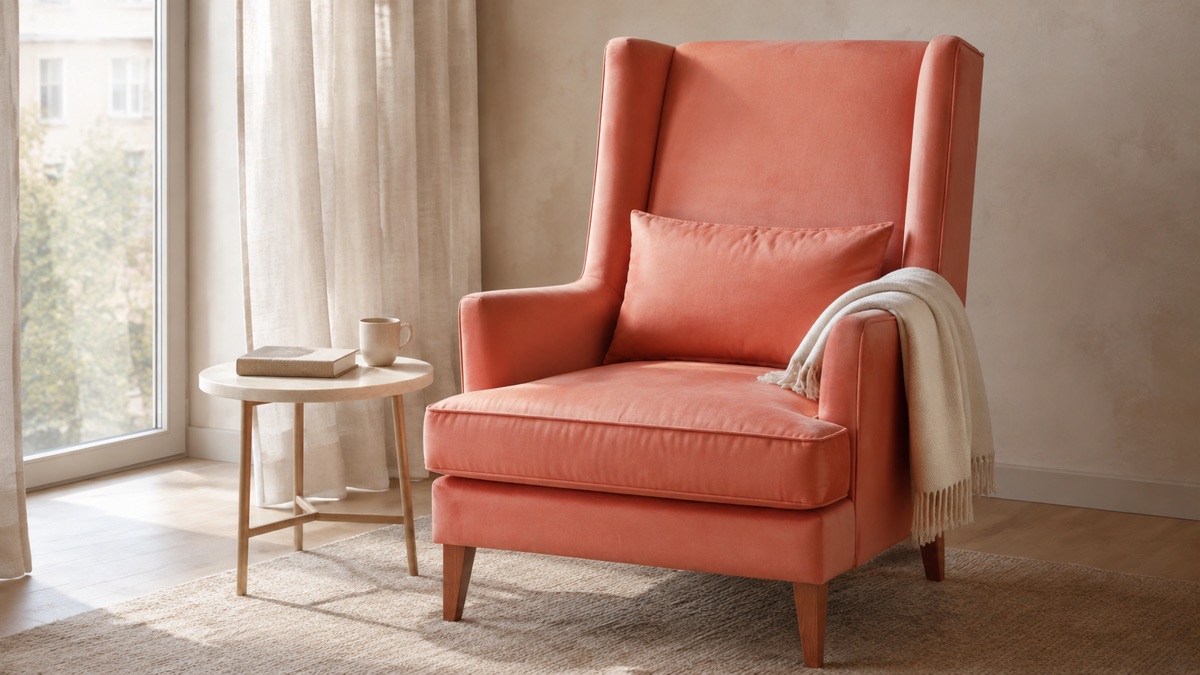
An armchair seems a simple thing until you start choosing one. And the main difficulty isn't that there are many options, but that an armchair for reading and an armchair for talking with guests are different objects that look the same in photos.
Let's go through the four parameters that really decide it.
Framed or frameless
The first fork in the road, and it's a fundamental one.
A framed armchair keeps its shape for years and works as a permanent seat. It's easy to get up from — an argument that carries more weight with age.
A beanbag chair (AIR, REST) is filled with beads and takes the shape of your body. It weighs a few kilograms, can be carried with one hand, has no sharp corners and costs many times less. It works best in a kids' or teenager's room or as an extra seat for guests.
The honest downside of a beanbag: it's harder to get up from a deep one, and it holds its shape worse than a framed armchair. As the main seat in a living room it's not the best choice.
Depth: where your knees end up
The parameter people most often get wrong, because you can't see it in a photo.
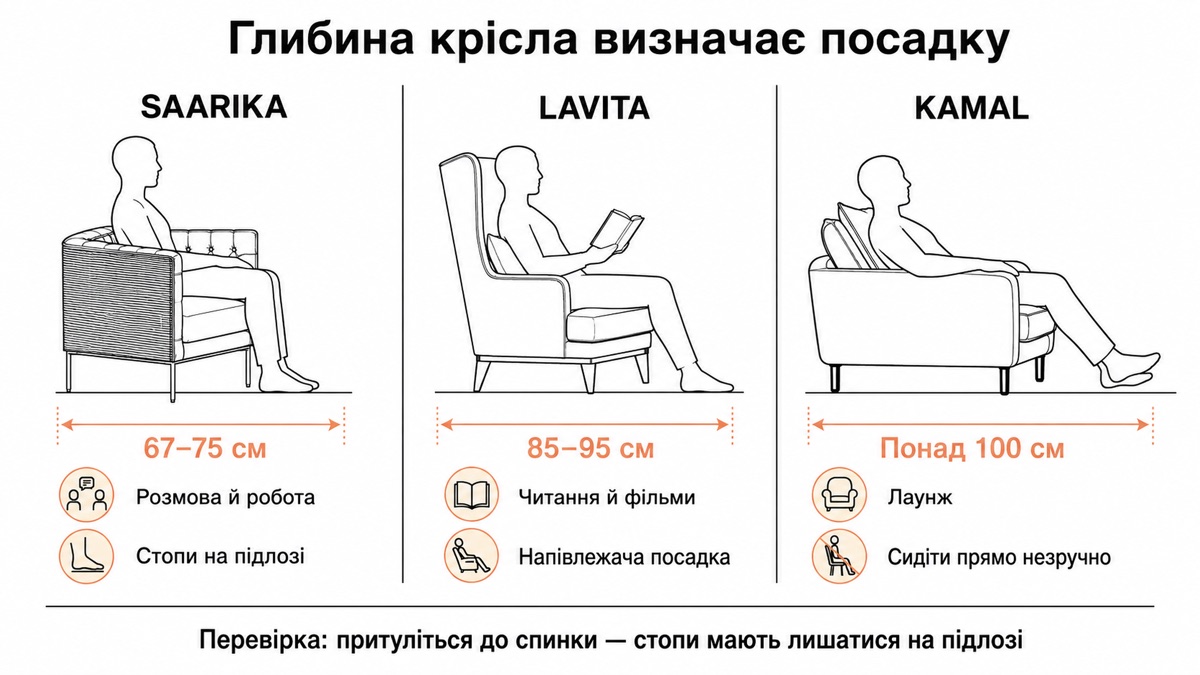
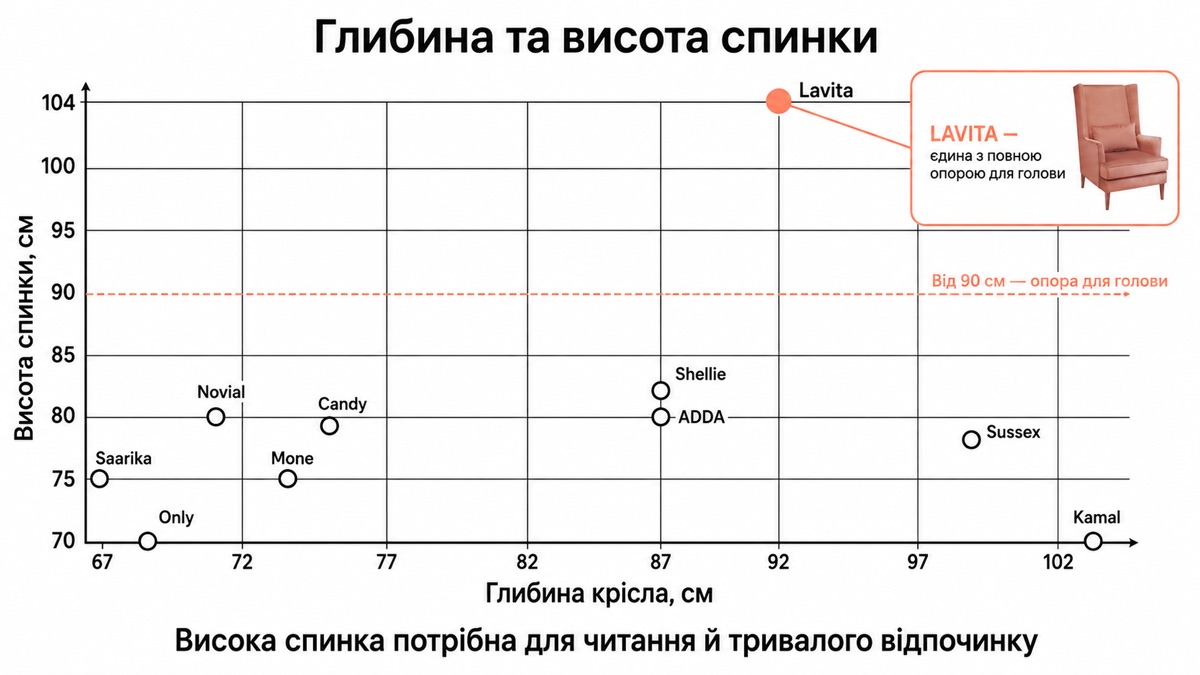
Our range varies a lot: Saarika — 67 cm, Only — 69, Novial — 71, Mone — 73, Candy — 74, ADDA and Shellie — 87, Lavita — 92, Sussex — 98, Kamal — 102 cm.
- 67–75 cm — upright seating. Back vertical, feet on the floor. This is an armchair for conversation, for paperwork, for a short rest.
- 85–95 cm — half-reclined seating. You can lean back, tuck your feet up, change position without getting up. The optimum for reading and films.
- Over 100 cm — lounge. You can't sit upright in such an armchair: your thigh ends before the seat does, and your back is left without support.
The check is simple: sit down and lean your back against the backrest. If your feet lift off the floor, the armchair is too deep for you.
Backrest height: is there somewhere to rest your head
The second most important parameter and the main cause of disappointment.
When you read or watch a film, after twenty or thirty minutes your neck gets tired and you want to lean back. If the backrest ends at shoulder-blade level, there's nothing to lean back on.
Our heights: Kamal and Only — 70 cm, Mone and Saarika — 75, Sussex — 78, Candy — 79, ADDA and Novial — 80, Shellie — 82, Lavita — 104 cm.
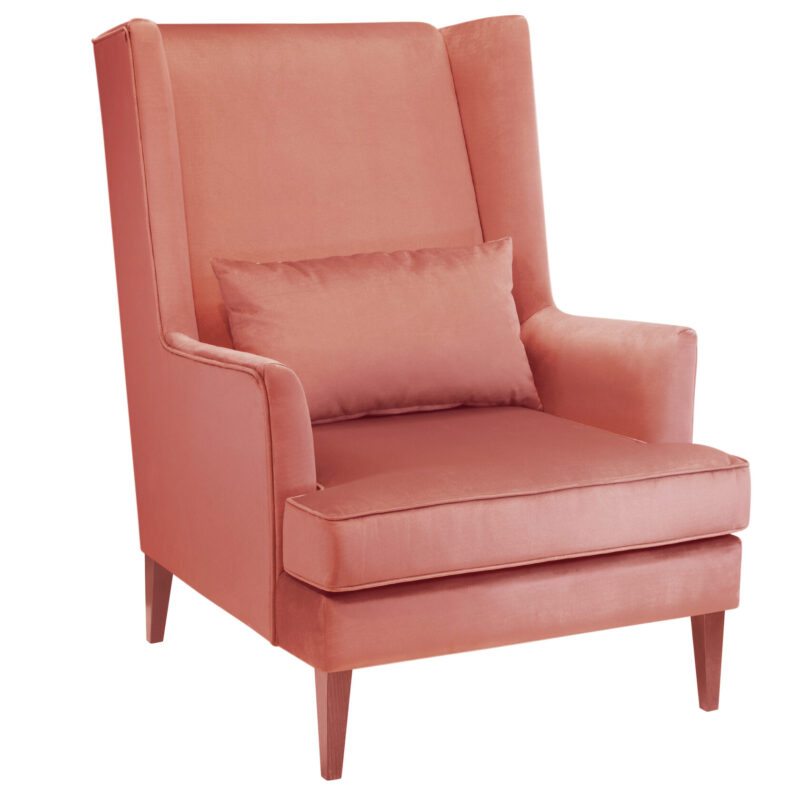
The honest conclusion: in our range, only one model gives full head support — Lavita (92 × 104 cm). The rest support the back but not the neck.
That doesn't make them worse — it makes them armchairs for a different use. And if you've fallen for another model for reading, a headrest cushion does about eighty per cent of the job. A detailed breakdown: a reading armchair.
Width: can you tuck your feet up
People don't think about it, yet it's half the comfort: people rarely sit straight in an armchair.
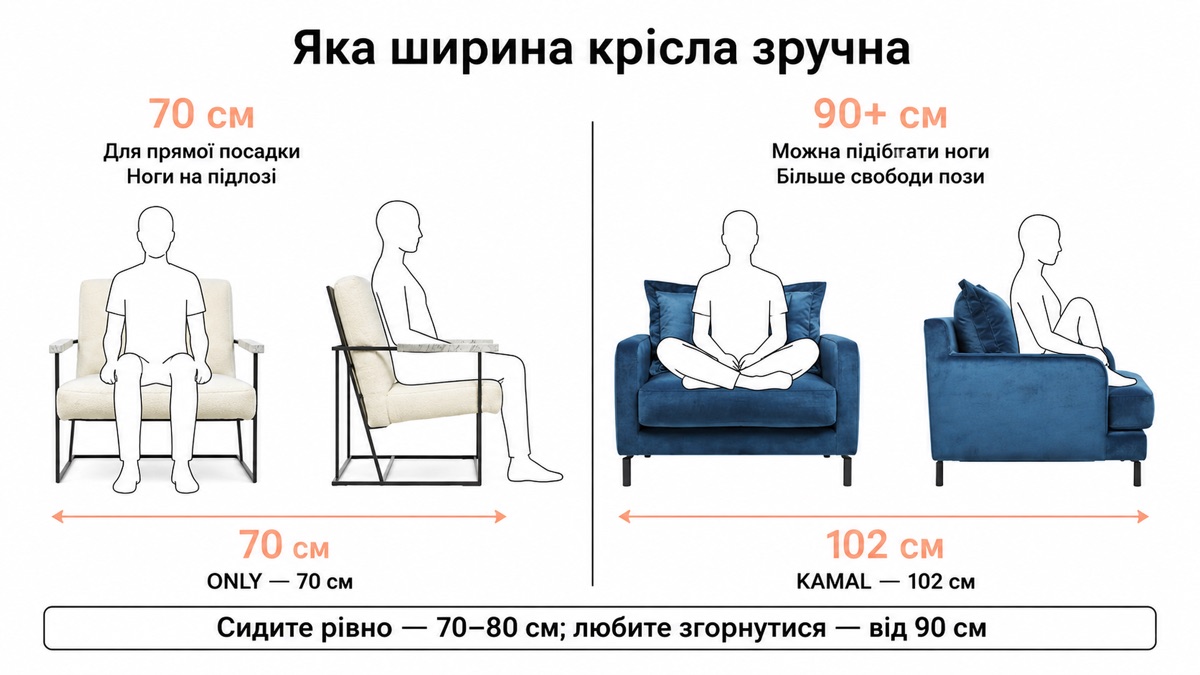
Only and Novial are 70 cm: comfortable to sit in, but no room to tuck your feet up. Shellie (94), Kamal (102) and Sussex (110) give room for any position.
The rule: if you sit upright, 70–80 cm is enough; if you like to curl up, take 90 cm or more.
What the armchair stands on
Ash — Lavita, Mone, Novial. A warm tone that works well next to wooden furniture and floors.
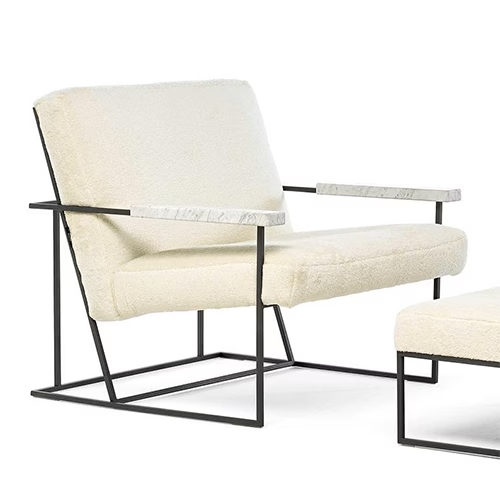
Metal — ADDA, Kamal, Only, Saarika, Sussex. Visually lighter: you can see the floor under the armchair, the room feels more spacious, and it's easier to clean.
Plastic — Shellie. Hidden supports make the armchair look like a single solid volume.
If the living room already has a TV stand or a table on metal legs, an armchair with the same supports will tie them together as a group.
Armrests
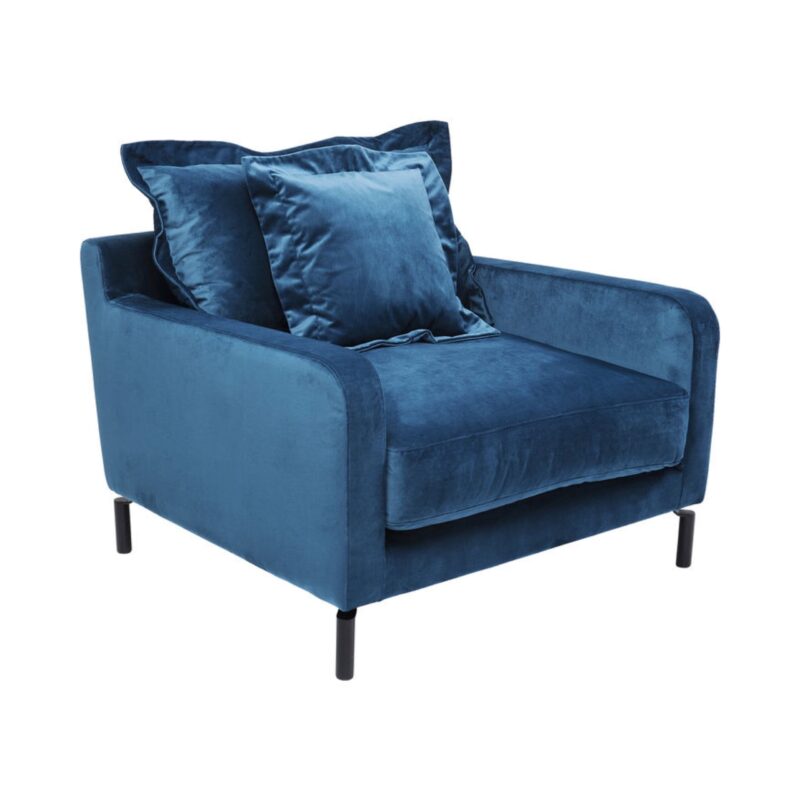
Almost all our framed armchairs have them — ADDA, Kamal, Lavita, Mone, Novial, Only, Saarika, Shellie, Sussex.
It's more useful to know when you're better off without them: without armrests an armchair is easier to push under a table, takes up less space in a walkway and looks more compact.
What to check when you look at one: the armrest should be at the height of a relaxed, lowered elbow. Too high and it lifts your shoulders; too low and you have to reach down — both get tiring within an hour.
Upholstery: 10 materials, and 13 on one model
The standard palette is ten materials: velour, chenille, velvet, corduroy, basket-weave fabric (rogozhka), woven fabric, microfibre, faux leather, eco-leather, Alcantara.
ADDA is the exception: thirteen options, and it's our only armchair available in genuine leather (plus faux suede and flock).
SUVI has its own shorter palette — velour, basket-weave fabric (rogozhka) and bouclé.
A practical tip: if the armchair will stand by a window on the sunny side, tell our manager. Fade resistance varies between collections, and it's a detail people only notice a year later. A general overview — types of upholstery fabric.
An armchair to go with a sofa
The most common scenario is buying an armchair after the sofa. There's a rule here people learn too late: the armchair shouldn't be a scaled-down copy of the sofa.
The same fabric plus the same form gives the feel of a nineties furniture-shop suite. It looks livelier to have an armchair of a different form in the same fabric — or the same form in a contrasting colour, but not both at once.
Since the armchairs are upholstered from the same collections as the sofas, both options are available.
Frequently asked questions
Which armchair should I choose for reading?
Two conditions are needed at once: a depth of 85–95 cm and a backrest from 90 cm. In our range, Lavita meets them. For other models, a headrest cushion does the job.
Does the armchair have to match the sofa?
No. Two approaches work — the same fabric or a deliberate contrast. The third doesn't: an "almost the same" shade. The difference will be noticeable and will read as a mistake.
A beanbag or a framed armchair for a kids' room?
A beanbag: it's light, has no sharp corners, the child can move it around on their own, and it costs many times less. As the main seat in a grown-up living room — a framed one.
Do you have armchairs in genuine leather?
One model — ADDA. The rest are available in faux leather and eco-leather.
Can the dimensions of an armchair be changed?
Yes. We make the backrest height, depth and armrest height to order — this makes more sense for an armchair than for other furniture, because comfort here is measured in centimetres, and everyone's height is different.
If you're looking for an armchair for the bedroom — where to put it and which size won't get in the way. If you need a chair with armrests for the dining table — how to check whether the armrests will go under the table.
In short
- Depth 67–75 cm — for sitting upright, 85–95 cm — for reading, over 100 cm — lounge
- A backrest lower than 90 cm doesn't support the head; in our range only Lavita does (104 cm)
- If you like to tuck your feet up, take a width of 90 cm or more
- The armrest should be at the height of a relaxed elbow
- 10 materials as standard; genuine leather — only on ADDA
Find an armchair for your interior — framed or frameless, with a wide choice of fabrics.
Go to the armchair catalogue →